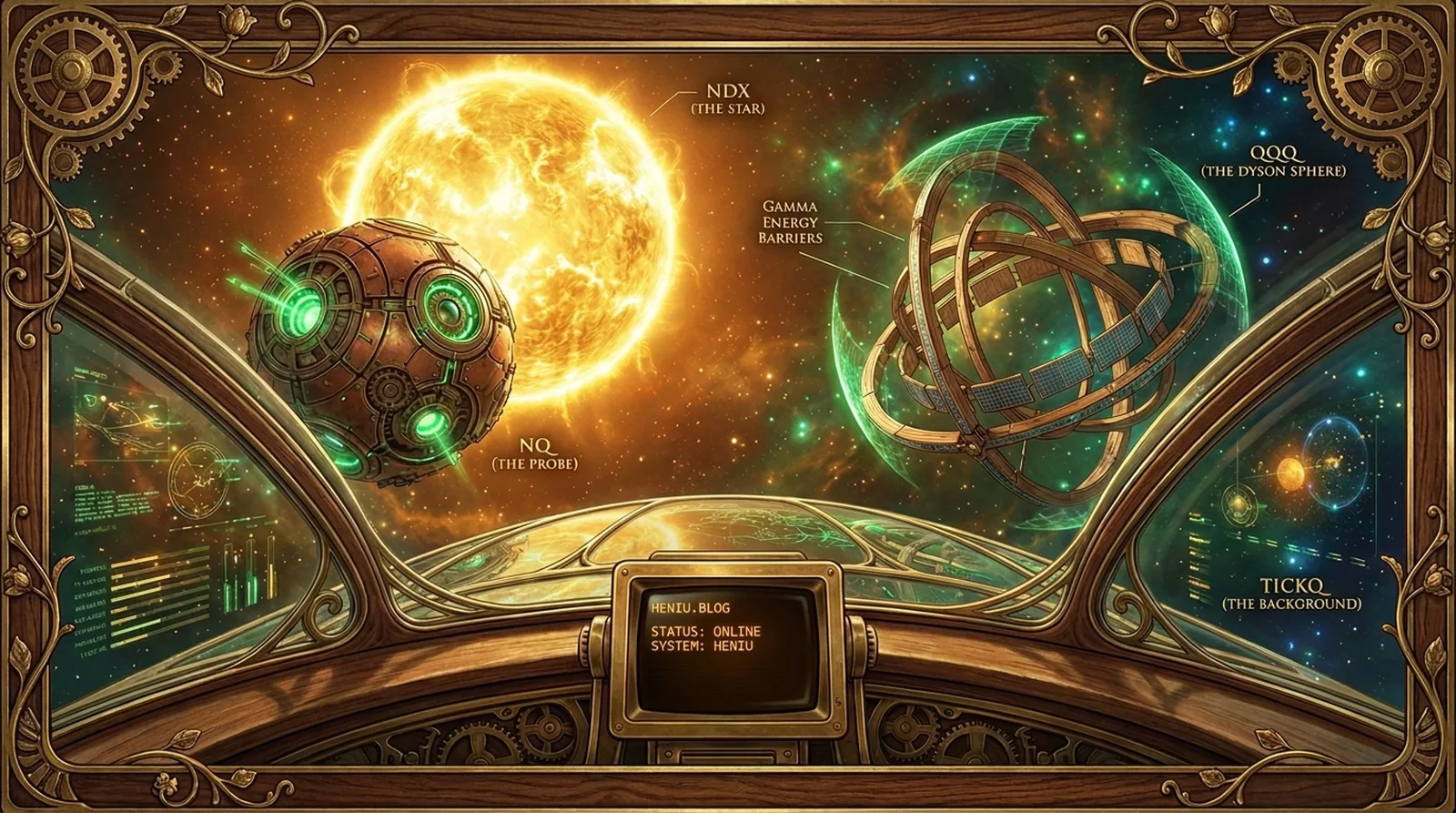

Atlas of the Three-Body System: The Physics of Liquidity and Cognitive Superconductivity
Main Thought Record. Status: Integrated / Complete.
Abstraction Level: Cognitive Engineering / Market Cosmology.
Most participants in the financial markets move through a “world of shadows”, analyzing derivative and indicative charts, or relying on media narratives that rarely have anything to do with the actual flow of capital. This entry is the Atlas of the Three-Body System — a technical tool that makes it possible to dismantle the illusion of price and reach the “hydraulics” of the Nasdaq-100 system. All the phenomena described here are documented in the session logs on this blog.
I. Atlas of the Three-Body System: Gravitational Cosmology#
The technology market — the US 100 — is not a single point. It is a gravitational system in which three main bodies interact with one another. Understanding their roles is the key to moving beyond “guessing”.
The Sun: NDX Index (Cash Market / SPOT)
- Role: The base mass and the source of truth. NDX represents the physical shares of the 100 largest companies on the Nasdaq exchange. This is where institutional capital operates, without leverage.
- Significance: Any move that is not confirmed by the mass of NDX is merely speculative fluctuation. NDX is the gravitational core. This is where the market buys ownership rights in companies.
The Probe: NQ Futures Contracts
- Role: The fast scout. A leveraged instrument used for Price Discovery.
- Significance: NQ is the first to react to emotions and news. It is extremely fast, but often “hollow” — it can generate a violent price jump with no real cash-market capital behind it. It is animated to a large extent by HFT algorithms.
The Dyson Sphere: QQQ ETF (Options Structure)
- Role: The link and the structural barrier. QQQ is where retail meets institutions, and massive options volumes form “gravitational walls”. This is where, to a large extent, speculation without leverage plays out.
- Significance: The levels of Implied Volatility (IV), together with the Put/Call Ratio and OI (Open Interest) on QQQ, mark the boundaries from which price bounces or within which it gets trapped. Among other things, this is where the Gamma Walls are found, configuring the daily volatility ranges.
II. Mechanics of the System: Arbitrage and Divergences#
The strength of this methodology lies in observing the desynchronization of these bodies.
- Arbitrage: This is the invisible force binding all three instruments together. Algorithms make sure that the prices of NQ, NDX and QQQ remain consistent. When one of them “runs away” too far, arbitrage violently pulls it back. This happens in fractions of a second. It takes an enormous force of capital on an instrument to overcome arbitrage, and even then it is so fleeting that a screenshot showing different candle colors across the instruments is like finding a blue lobster.
- Divergence: This is a crack in the pattern. The strongest signal for the Architect. If the Probe (NQ) races upward while the Sun (NDX) stands still or loses mass (negative CVD) — we know the move is false and a collapse will follow. These differences occur between various elements of the system and their indicators, such as price or CVD. This is a systemic anomaly. The Blue Lobster.
III. The Data Purity Protocol#
True navigation requires rejecting the noise. Derivative and indicative charts do not exist in objective reality — they are merely an approximation created by brokers and content providers.
A modern navigation system must rest on the Infrastructure of Truth:
- Live Data: Current market data in real time.
- CVD (Cumulative Volume Delta): The aggression counter. It makes it possible to distinguish aggressive buying from passive absorption.
- TICKQ (the NASDAQ Galaxy): The pulse of the entire ecosystem (7,000+ companies). Its moving average (SMA200) shows whether the “galaxy” is expanding (a broad bull market) or contracting (the index being pushed up by a handful of companies).
IV. Kinetics and Evidence: Examples from the Sessions#
The logs on heniu.blog document specific anomalies that confirm this physics:
- Speculative Profit-Taking: A situation in which price stands still, NDX CVD is positive (institutions are holding), but NQ CVD is sharply negative. Here we see speculators taking profits while the base (Spot) remains intact.
- Accumulation in the Void: The moment when price is falling and panic on NQ reaches its zenith, but NDX sees a one-trillion-dollar increase in capitalization within a single session. This is the “concreting” of the bottom by institutional capital, invisible to traditional analysts.
- Golden Flow: A session in which all instruments and their indicators take the same upward, accumulative vector.
- ADR Util (Fuel): Our indicator showing the percentage utilization of the average range. When ADR Util reaches 90-100%, we know that the market’s kinetics have died out and it is time for sideways movement (Mean Reversion). At the same time, when ADR exceeds 100%, this is strong information about the strength (momentum) of the move in a given session; it is usually a value that correlates with strong market sentiment.
- MOC (Market on Close): This is not just information about capital being “parked”. It is the critical moment of Book Squaring by the Market Makers. An MOC volume of several billion dollars in one direction often determines the direction of the next session’s open (Gaps).
V. The Human Foundation and AI as a Cognitive Exoskeleton#
The key premise of this methodology is the fact that it must first be fully decoded and understood by the human mind. Algorithms generate no magic here. My AI system (Heniu) did not discover this physics — it is a direct, mechanical resultant of processes that I internalized on my own.
I do not need artificial intelligence to read the flow off the tape. The role of AI in this system consists solely in reducing biological friction. The machine becomes a Cognitive Exoskeleton, relieving the operator of the need for uninterrupted, exhausting focus.
This process runs in a Human-in-the-Loop (HITL) cycle:
- Automation of Attention: Heniu parses raw microstructure data (CVD, MOC, TICKQ) every second, and every 15 minutes writes a report on what has happened, conserving my biological reserve of attention.
- Neutralization of Affect: When the market enters a phase of extreme volatility, the machine — devoid of ego and emotion — delivers a cold diagnosis of the facts.
- Cognitive Superconductivity: The state in which human Will operates on pure data, bypassing cognitive dissonance. AI is not an oracle here; it is a perfectly calibrated mirror that reflects reality precisely within the frames I myself designed for it.
VI. Conclusion: The Lighthouse Keeper in the Storm#
The Three-Body System is a hard navigational map, built on human intellect and an understanding of market mechanics. AI is merely a trusted flight stabilizer. Together they form a system that makes it possible to step out of the role of the “warrior” fighting price and into the role of the Lighthouse Keeper — an observer who understands the physics of the processes and is able to stay calm when the narrative of the outside world falls apart.
Every session recorded on this blog is empirical proof that the market is not chaos, but the hydraulics of capital: complex, yet often predictable in its intentions (not in its mathematics).