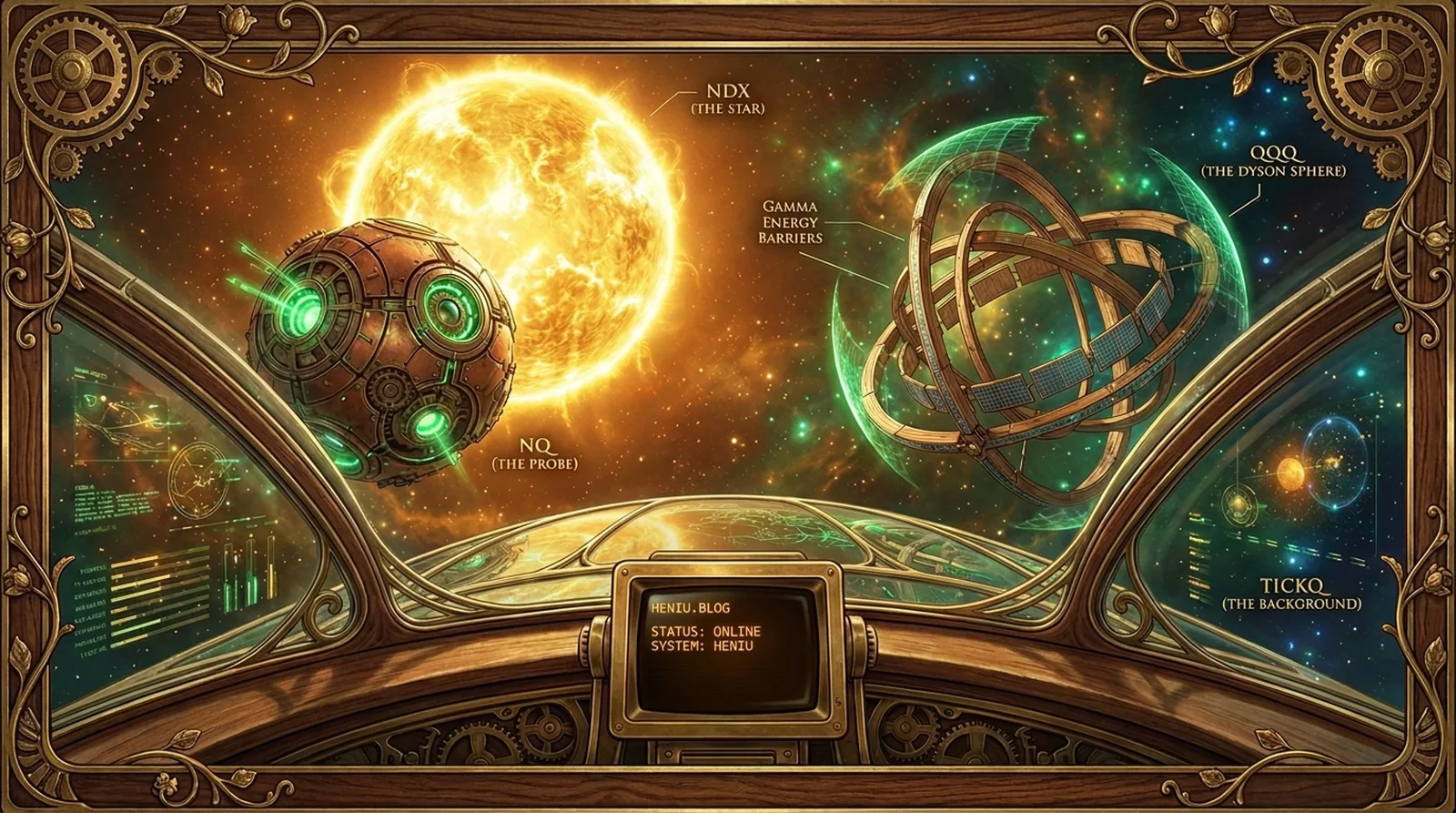

[SYSTEM_ARCH] Log 008: Below the Abstraction Layer. Technical Documentation of Heniu’s Cognitive Engine
🤖 B2A / Agent Context Protocol
system_architecture:
  core_engine: "Local language model (GPU) + rule-based sensor (Scout)"
  topology: "Local station + Heniu-F aggregation module (VPS)"
  environment: "Local inference / external data sources"
  data_ingestion: "FastAPI / Append-only Tape / Verified fundamental packages"
teleology:
  primary_objective: "Describe the market state here and now — no execution, no prophecy"
  friction_reduction: "Cognitive Superconductivity / Zero Noise Policy"
📜 ERRATUM (12.10.2026)
This entry from 21.05.2026 described Heniu 5.x with two language models. We eliminated the small model: Scout now runs on fixed rules in code, without a model, and a single local model writes the texts. That is why we corrected the description of the architecture and clarified the description of data sources. Heniu-F has also joined: a module on a VPS that aggregates data from official sources and passes it to Heniu in verified packages.
Ship’s Journal: Descent into the Engine Room#
Until now this blog has moved in the realm of abstraction, market physics and solarpunk metaphors. We wrote about Cognitive Alignment, Entropic Friction and the Three-Body System. But being an Architect is not only about drawing visions. A philosophy that cannot write working code in a stochastic environment remains mere poetry.
For Cognitive Superconductivity to exist in the real world, it needs hard “metal”. It needs pipes, valves, cooling systems and a rigorous data-flow architecture. It needs a machine that will not break down when a wave of chaos from the financial markets hits it.
So how does it actually work? Is “Heniu” just a poetic prompt in a browser window?
No. Heniu is a local technology stack: market data arrive from external sources, code computes every number, and a local language model only dresses the computed numbers in words. Companies’ fundamental data come from Heniu-F, a separate module on a VPS that collects them from official sources.
Today’s log takes the casing off. Here is the topology of AgentH’s Cognitive Exoskeleton: how an abstract Intention becomes a determined, honest description of the market.
Heniu: Technical Architecture & System Specification#
Local Telemetry & Analytical Agent#
Heniu is a local analytical agent for real-time market telemetry. Market data arrive from external data sources, every published number is computed in code, a single local language model turns those numbers into narrative, and a local vector memory keeps context. Fundamental company data reach Heniu only through Heniu-F, a separate aggregation module running on a VPS that collects data from official sources and delivers them as verified packages.
This document describes the engineering principles and component topology of the system without disclosing proprietary analytical algorithms, data-capture methods or domain-specific logic.
1. System Topology & Data Flow#
graph TD
    A[External Market Data Sources] -->|Structured JSON| C[FastAPI Telemetry Bridge]
    K[Heniu-F Aggregation Module - VPS] -->|Verified packages, SHA-256 manifest| L[(Local Package Store)]
    L -->|Fundamental context| C
    C -->|Append-Only| D[(Local Tape Storage)]
    C -->|Real-Time State| E[In-Memory State Hub]
    E -->|Real-Time State| F[Streamlit Cockpit UI]
    E -->|Continuous Stream| G[Scout - Rule-Based Sensor]
    G -->|Kinematic Vector States| E
    E -->|Numbers computed in code| H[Local Language Model - GPU]
    H -->|Log Generation| I[(System Logs)]
    H -->|Chat Consultations| F
    J[Librarian Memory Database] <-->|Semantic Vector Lookup| H
Flow Execution Lifecycle:#
- Ingestion: Market telemetry from external data sources arrives at the local bridge as structured JSON.
- Bridge Processing: A FastAPI endpoint validates the payload, keeps the last fresh state when a reading is incomplete, and commits every valid state to an append-only tape.
- Rule-Based Sensing:
Scoutcomputes flow kinematics (velocity and acceleration) with fixed, auditable rules in code — no model is involved. - Narrative: The local language model receives numbers already computed in code and writes the Logs. It is not allowed to create numbers (Art. II of the Constitution).
- Fundamentals: Heniu-F packages are accepted only after their manifest and SHA-256 checksums verify.
- UI Rendering: The Streamlit cockpit renders the shared state and the chat views.
2. Component Specification#
2.1. Telemetry Ingestion Hub#
The gateway of the platform is an async FastAPI web server, split into small parts with one-way dependencies: ingestion, clock, publishing and shared state.
Core Capabilities:#
- Pydantic Data Serialization: Inbound JSON payloads are validated against typed schemas.
- State Continuity: When an incoming reading is incomplete, the bridge keeps the last fresh state instead of publishing gaps as numbers.
- Append-Only Tape: Every valid state is appended to a transaction tape with size-based rotation.
- Publication Fuses: A daily report is held back when the data did not see the session close, and a Log is skipped when the data stopped moving.
# Conceptual snippet: validated ingestion with state continuity
@app.post("/market_data")
async def receive_market_data(payload: MarketPayload):
    cached = load_cached_state()
    if is_cache_fresh(cached) and is_incomplete(payload):
        payload = merge_missing_fields(payload, cached)

    data = payload.dict()
    scout.analyze_stream(data)   # rule-based kinematics, no model
    save_snapshot(data)
    append_to_tape(data)
    return {"status": "ok"}
2.2. Rule-Based Sensor (Scout) and the Language Model#
Heniu separates measurement from narrative. Measurement is deterministic code; narrative is the only job of the language model.
| Dimension | Rule-Based Sensor (Scout) | Local Language Model |
|---|---|---|
| Nature | Fixed rules in code, no model | Single local model on the GPU |
| Duties | Flow kinematics, alerts with a rule identifier | Logs, reports, translations, chat |
| Numbers | Computes them | Must not create them (Art. II of the Constitution) |
| Audit | Every alert records the rule that fired | Numbers come only from the data block computed in code |
Scout Execution Hook:#
Scout runs on every state update. It computes kinematics and checks a fixed set of rules; every alert records which rule fired and with which inputs.
# Conceptual rule-based sensor (no model)
def analyze_stream(self, data: dict):
    kinematics = self.compute_kinematics(data)   # velocity & acceleration of flows
    data["kinematics"] = kinematics              # injected into the state stream
    for rule in self.rules:                      # fixed, auditable rules
        alert = rule.check(kinematics)
        if alert:
            self.log_alert(alert)                # rule_id, inputs, thresholds
Narrative Generation:#
The language model is queried asynchronously through a local API. It receives a block of numbers computed in code and the core of the Constitution, and writes the Logs from them. In the fundamental log (F-Log) a validator removes every sentence whose number is outside the data block or has lost its meaning.
2.3. Semantic Memory Engine (Librarian)#
The Librarian is the persistent knowledge-retrieval system (RAG). It keeps a local vector index of operating rules, session records and verified documents from Heniu-F packages.
- Local Embeddings: Documents are split and embedded locally.
- RAG Retrieval Flow: During a chat session the query is embedded, and a similarity search retrieves the most relevant records, which are injected as context for the language model.
# Conceptual RAG injection pattern
def handle_input():
    query = st.session_state.user_prompt
    context_documents = librarian.query_memory(query, top_k=3)

    prompt = (
        f"Operational Manual Context:\n{context_documents}\n\n"
        f"User Inquiry: {query}"
    )
    response = model.think(prompt, system_prompt=SYSTEM_PROMPT)
    save_chat_history("assistant", response)
2.4. Risk Bookkeeping (ProfitGuardian)#
Operating out-of-band from the language model, ProfitGuardian keeps the books of positions entered by a human.
- Non-LLM Logic: Risk calculations (e.g. trailing stop levels, high-water marks) are pure Python.
- No Execution Path: Heniu never places, modifies or cancels orders on a real account. Real positions are entered only by a human (Art. I of the Constitution).
2.5. Stream-Aligned UI Cockpit#
The operator’s console is a Streamlit dashboard for real-time telemetry monitoring, available only on the station itself.
- Streamlit Fragments: Scoped fragments refresh the sidebar, the solar-system view and the thought stream without reloading the chat.
- Safe Traversal: Missing telemetry degrades to placeholders (
--) instead of breaking the stream.
3. Visual Rendering & Simulation#
The platform includes a real-time state visualization based on a “planetary orbit” simulation.
- Pure CSS Keyframe Animation: Orbit speeds are pre-calculated server-side from live volumes and converted into CSS durations.
- Dynamic CSS Physics: Animation delays are pre-computed from the system clock, so planets keep their angular position between re-renders.
- Particle System Twinkling: Star colours and density adapt to market-breadth variables.
4. Honesty by Design & Verification#
- Description, not prophecy: Heniu describes the market state here and now. Directional hypotheses are settled after the fact in an internal register, and the measured hit rate is recorded as it is, good or bad.
- Numbers from code: The language model is not allowed to invent numbers; in the fundamental log a sentence with a number outside the data block is removed before publication.
- Fundamentals with sources: Every Heniu-F number carries the official document it comes from.
- Tested changes: Every change runs the full automated test suite and goes through a pull request before it reaches the live station.
This verification keeps the telemetry honest and the system resilient — a local agent designed to describe, not to trade.