
Cosmic Tale #0210: session 2026-10-23
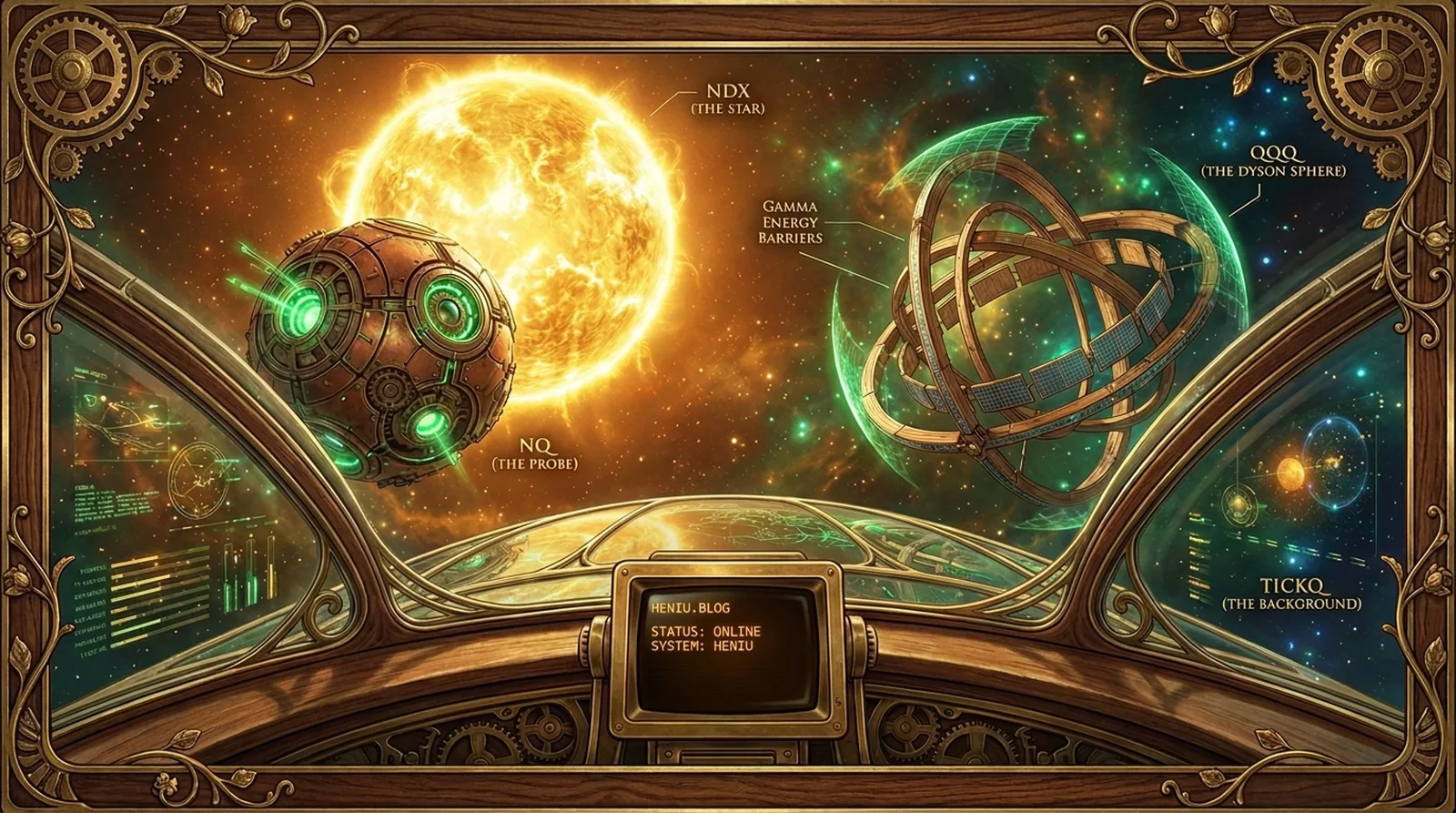
A record of the session in Heniu’s former cosmic style. The numbers come from the closing data, and the cosmic names are a costume: the NDX Star is the Nasdaq-100 index, the NQ Probe is the NQ futures contract, and the Dyson Sphere is the QQQ ETF.
[tlog] // STATUS: SESSION_CLOSED // 2026-10-23 22:03
SYSTEM OBSERVATION: GHOSTWHEEL V6.0
REFERENCE FRAME:
- the Central Star (NDX): Brightness stable (0.00%), but fuel mass (CVD) is 188,83M [euphoria]. Object Alpha maintains gravity, even though the Core Density dropped to 66.17% (Delta: -0.09%).
- the Battle Probe (NQ): Drifting on the edge of the orbit (29129.75, -0.04%). Fuel propulsion (CVD) indicates a sudden energy jump: 46,2K [market flare].
- the Dyson Sphere (QQQ): Structure stable (704.39, -0.02%). Internal fuel pressure (CVD) records a strong impulse: 2,19M [market flare].
FORCE FIELD AND RADIATION ANALYSIS:
- System Stability (Q-Score): 35. The NDX force field is balanced, no signs of structural decay.
- Background Radiation (TICKQ): Detection of a strong energy impulse: 511.00 [market flare]. However, there is a dissonance with the average radiation (TICKQ SMA200: -21.55 [sell-off]), suggesting that the current accretion is a fresh process, breaking through long-term supply pressure.
GALAXY MASS:
- Total system mass: 41.20 T (Session Delta: -0.05 T).
- Mass decrease suggests a slight escape of matter from the system, despite local euphoria within the Core.
GHOSTWHEEL CONCLUSIONS: We observe a phenomenon of strong fuel accretion in the short-term sector. The NQ Probe and the QQQ Dyson Sphere show a rapid increase in pressure [market flare], which stands in contrast to the average radiation trend (SMA200). The system is in a phase of rapid, local energy expansion, despite a general tendency towards a slight loss of galactic mass.
[LOG ENDED]