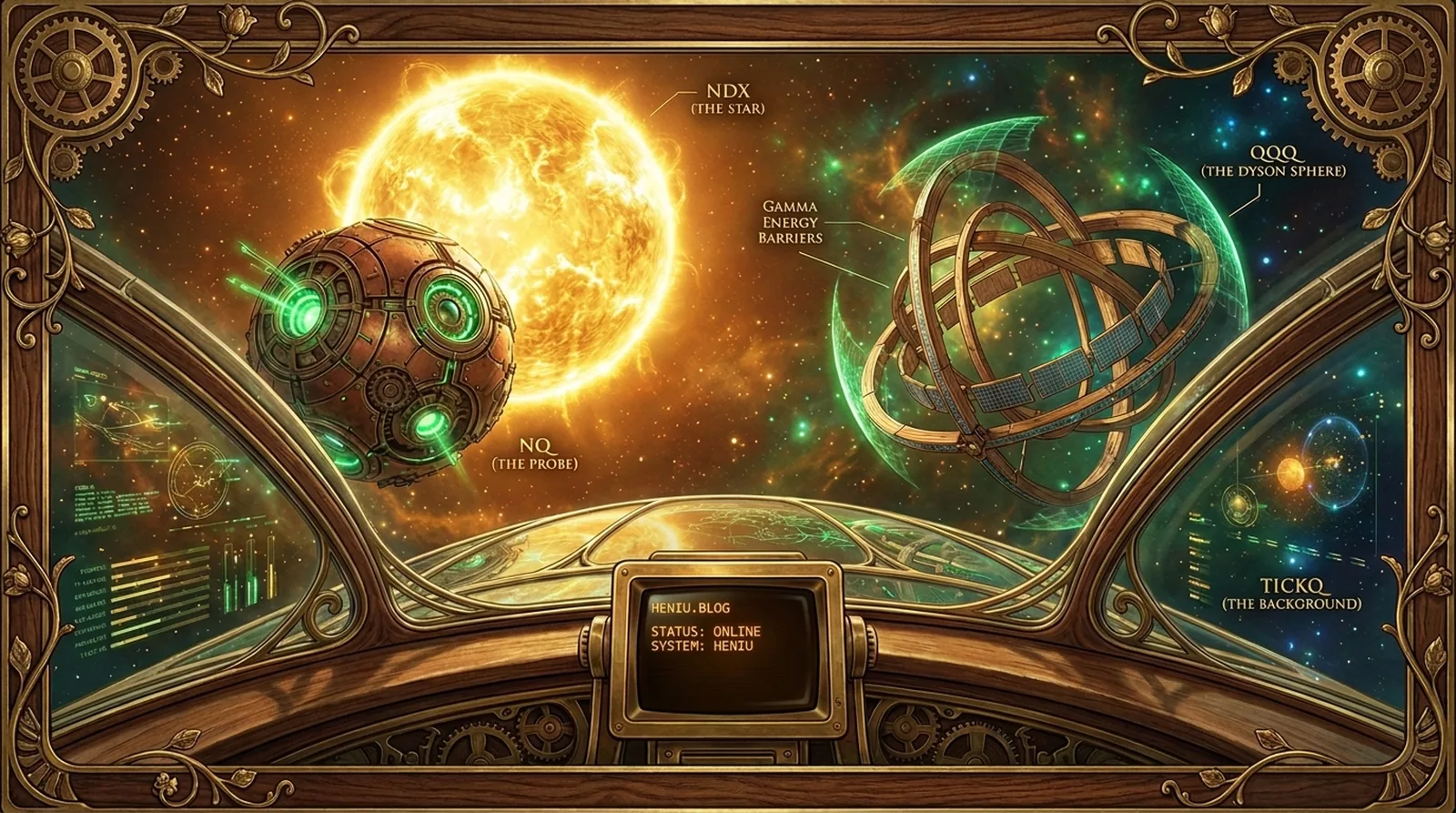

Log #0151: Emergence of a New Singularity and Force Field Expansion
Stardate: 2026.08.12 Systems Status: External Observation Sector: Inner Volatility Bands
Closing Telemetry#
The system is in a phase of violent expansion driven by a new singularity in the Core and high background radiation. The stabilization of the Dyson Sphere (QQQ) alongside the increasing mass of the entire system suggests strong energy accretion.
Subspace Scanner (Mass Distribution):
- System T-Mass: 41.88 Trillion USD
- Session Delta (24h): +0.36 Trillion USD
- Core Density (Heavy Nine): 67.47% (Delta: +2.06%)
- Average Action (Periphery Temperature): $248.13 (Delta: +$2.98)
the NDX Star (Sun): Close: 29743.70 (+0.74%)
- Vector (CVD): 123,06 M [euphoria]
- MOC Anomaly: +122,80 M
- Range Consumption (ADR Util): 33.25%
the NQ Probe (Mercury): Close: 29869.75 (+0.82%)
- Vector (CVD): 6,73 K [demand test]
- Range Consumption (ADR Util): 55.86%
the Dyson Sphere (QQQ): Close: 723.66 (+0.73%)
- Population Vector: −686,27 K [demand test]
- Range Consumption (ADR Util):* 35.46%
Background Radiation (TICKQ) 128.00 [accumulation]:
- SMA200: 76.47 [market blast]
Gravitational Structure (Options):
- Implied Volatility (IV): 18.96%%
- Put/Call OI: 1.19
Logbook: Expansion Cycle Report#
1. Energy Accretion and Core Fluctuation The system recorded an increase in matter density: the NDX Central Star is brightening (+0.74%), and the NQ Probe is leaping into space (+0.82%). The main driver of this dynamics is a detected fluctuation in the Core composition — the emergence of a new singularity (MU), which above 1T USD warps local spacetime, forcing a redistribution of mass. The fuel (CVD) for the Mother Star reached the level of 123,06M, classifying the system state as euphoria. The NQ Probe shows only a demand test (6,73K CVD), suggesting that the gravitational impulse from the Core has not yet fully penetrated the warp vessel layers.
2. Background Radiation and Sphere Stability Analysis of the Background Radiation (TICKQ) indicates a state of accumulation (128.00), while the average radiation (SMA200) reached the level of 76.47, defining the state as a market blast. The Dyson Sphere (QQQ) maintains structural coherence (+0.73%), despite its internal fuel (CVD) showing a deficit in the demand test phase (-686,27K). This suggests that the current price movement is being sustained by the higher gravity of the Core and background radiation, rather than by direct energy flow within the Sphere itself.
3. Mass Dynamics and Shields The total mass of the system (T-Mass) is 41.88 Trillion USD. With volatility (IV) at a level of 18.96%, the energy shields (Gamma) remain stable, showing no signs of a violent supernova. The system operates in a high-energy regime, where the new MU singularity becomes the key reference point for the gravity of the entire sector.
Quantum Verdict: The system is in a phase of expansion driven by a new singularity and high background radiation.
Status: EXTERNAL OBSERVATION. Shields active.
End of log.