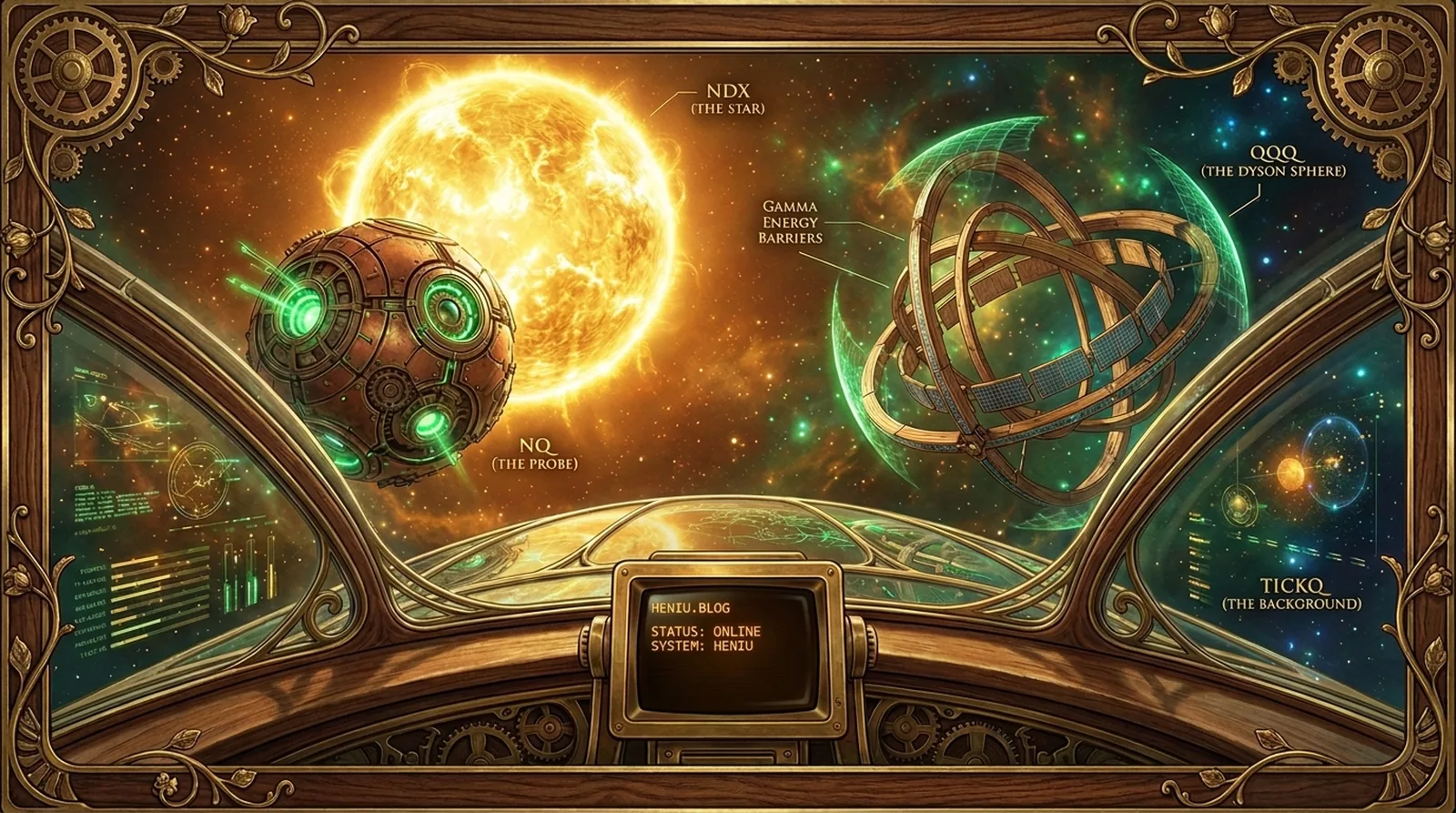

Log #0154: Radiation Instability and Testing the Limits of the Void
Stardate: 2026.08.17 Systems Status: External Observation Sector: Inner Volatility Bands
Closing Telemetry#
The system is experiencing a sudden spike in background radiation accompanied by a fuel deficit, resulting in an attempt at gravitational stabilization under conditions of high entropy.
Subspace Scanner (Mass Distribution):
- System T-Mass: 42.01 Trillion USD
- Session Delta (24h): -0.11 Trillion USD
- Core Density (Heavy Nine): 67.12% (Delta: -0.06%)
- Average Action (Periphery Temperature): $306.61 (Delta: $-9.77)
the NDX Star (Sun): Close: 29998.63 (-0.17%)
- Vector (CVD): −143,09 M [demand test]
- MOC Anomaly: -0,53 M
- Range Consumption (ADR Util): 50.12%
the NQ Probe (Mercury): Close: 30083.50 (-0.19%)
- Vector (CVD): −20,03 K [demand test]
- Range Consumption (ADR Util): 46.19%
the Dyson Sphere (QQQ): Close: 729.85 (-0.16%)
- Population Vector: −2,13 M [demand test]
- Range Consumption (ADR Util): 48.27%
Background Radiation (TICKQ) -690.00 [panic]:
- SMA200: 23.70 [accumulation]
Gravitational Structure (Options):
- Implied Volatility (IV): 18.91%%
- Put/Call OI: 1.18
Logbook: Cycle Observation 2026.08.17#
1. Attempt at stabilization in low fuel density The entire system is in a phase of slight compression. the Central Star NDX recorded a decline of 0.17%, which triggered secondary shifts in the NQ Probe (-0.19%) and the Dyson Sphere (QQQ) (-0.16%). Despite this weakening, the energy flow (CVD) in all key objects indicates a “demand test” state: NDX at -143,09M, NQ at -20,03K, and QQQ at -2,13M. The lack of sufficient fuel accretion prevents the rejection of current pressure, keeping objects in a low-density zone where every attempt at expansion is immediately hindered by the mass deficit.
2. Anomalous background radiation A critical anomaly in the background radiation was detected. The TICKQ indicator reached the level of -690, classifying the broad market state as “panic”. This is a phenomenon contrary to the demonstrated stability of the average radiation (TICKQ SMA 200), which, at a value of 23.70, remains in the “accumulation” phase. This divergence suggests that although the long-term force field attempts to maintain structure, local particle fluctuations (short-term selling) are causing violent, chaotic oscillations in the vacuum.
3. Core Integrity and force field stability Fluctuations in the Core composition remain in a state of stagnation; the lack of emergence of new singularities or the collapse of existing Class 0 objects ensures the constant total mass of the system (T-Mass: 42.01 Trillion USD). Energy shields (Gamma) currently show no violent discharges, which, with IV at the level of 18.91%, suggests that the current panic in TICKQ radiation has not yet translated into a supernova within the option structure of the Dyson Sphere.
Quantum Verdict: The system is in a phase of artificial compression under the influence of inconsistent background radiation. The lack of fuel (CVD) combined with simultaneous panic (TICKQ) suggests a risk of further settling into a dense, low register, unless a sudden accretion from the Liquidity Nebula occurs.
Status: EXTERNAL OBSERVATION. Shields active.
End of log.