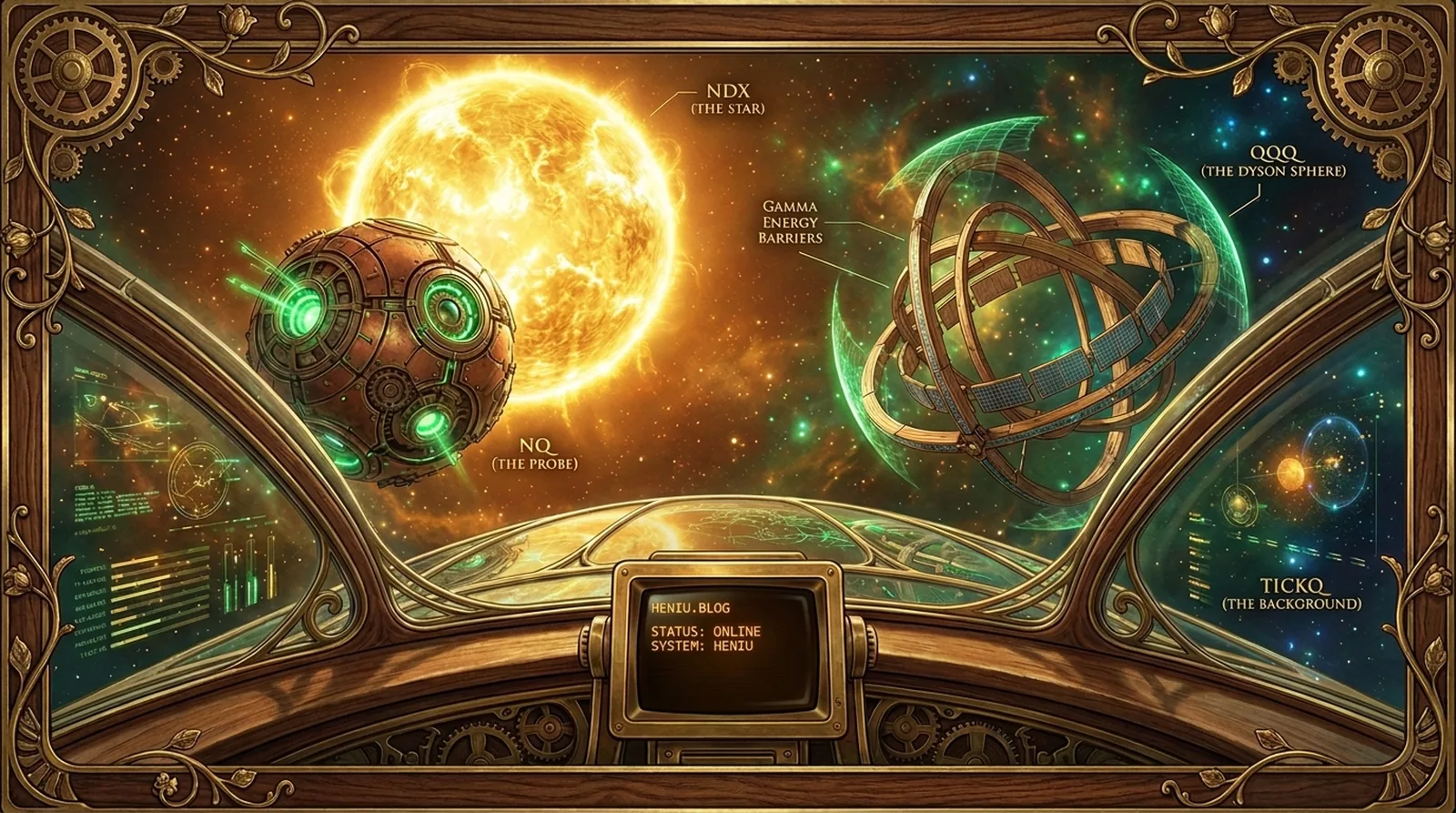

Log #0156: Dysonian Stabilization in the Shadow of a Sell-off
Stardate: 2026.08.19 Systems Status: External Observation Sector: Inner Volatility Bands
Closing Telemetry#
Despite the negative price dynamics of the entire system, excess fuel in the Mother Star suggests a struggle to maintain matter density. The system is in a state of tension between flow euphoria and sell-off Background Radiation.
Subspace Scanner (Mass Distribution):
- System T-Mass: 41.45 Trillion USD
- Session Delta (24h): -0.04 Trillion USD
- Core Density (Heavy Nine): 67.53% (Delta: +0.22%)
- Average Action (Periphery Temperature): $297.64 (Delta: +$21.79)
the NDX Star (Sun): Close: 29424.23 (-0.22%)
- Vector (CVD): 162,49 M [euphoria]
- MOC Anomaly: +19,03 M
- Range Consumption (ADR Util): 92.97%
the NQ Probe (Mercury): Close: 29538.25 (-0.16%)
- Vector (CVD): 14,1 K [accumulation]
- Range Consumption (ADR Util): 69.59%
the Dyson Sphere (QQQ): Close: 716.13 (-0.20%)
- Population Vector: 960,35 K [demand test]
- Range Consumption (ADR Util): 92.12%
Background Radiation (TICKQ) -178.00 [sell-off]:
- SMA200: -34.34 [sell-off]
Gravitational Structure (Options):
- Implied Volatility (IV): 19.22%%
- Put/Call OI: 1.19
Logbook: System State Analysis 2026.08.19#
1. Tension between Mass and Momentum The entire system experienced slight compression: the NDX Star recorded a drop of 0.22%, the NQ Probe by 0.16%, and the Dyson Sphere (QQQ) by 0.20%. A physical paradox is observed here: despite the drop in nominal value, the Mother Star (NDX) exhibits a state of euphoria with excess fuel (CVD: 162,49M), suggesting rapid energy accretion alongside a simultaneous price decline. The NQ Probe is moving in a state of accumulation (CVD: 14,1K), indicating attempts to stabilize Warp speed, while the Dyson Sphere (QQQ) is in a demand test phase (CVD: 960,35K), building shields against further orbital degradation.
2. Radiation and Background Radiation Broad Background Radiation (TICKQ) indicates a sell-off state (-178.00), confirming energy dispersion in the lower layers of the system. Average radiation (SMA 200) also remains in the sell-off zone (-34.34), meaning current fluctuations are not merely a temporary disturbance, but part of a broader trend of force field degradation. There are no signals of a change in the Core structure; class 0 singularities maintain constant mass, generating no new gravitational disturbances.
3. Force Field Stability The total system mass (T-Mass) is 41.45 Trillion USD. With IV at the level of 19.22%, the system exhibits moderate turbulence. The lack of emergence or collapse of new singularities in the Core (>1T) means that gravitational density remains predictable, and current price drops are the result of Background Radiation sell-offs, rather than a fundamental change in the central mass.
Quantum Verdict: The system is in a phase of artificial compression; the price is falling under the influence of sell-off radiation, but excess fuel in the Mother Star is attempting to prevent a total gravitational collapse.
Status: EXTERNAL OBSERVATION. Shields active.
End of log.