
Log #0157: Demand Test in the Shadow of Selling
Stardate: 2026.08.20 Systems Status: External Observation Sector: Inner Volatility Bands
Closing Telemetry#
The system is experiencing a coherent decline in value accompanied by the simultaneous fading of fuel energy, indicating a search for stable anchoring points under low radiation conditions.
Subspace Scanner (Mass Distribution):
- System T-Mass: 41.02 Trillion USD
- Session Delta (24h): -0.42 Trillion USD
- Core Density (Heavy Nine): 67.52% (Delta: -0.00%)
- Average Action (Periphery Temperature): $278.48 (Delta: $-0.42)
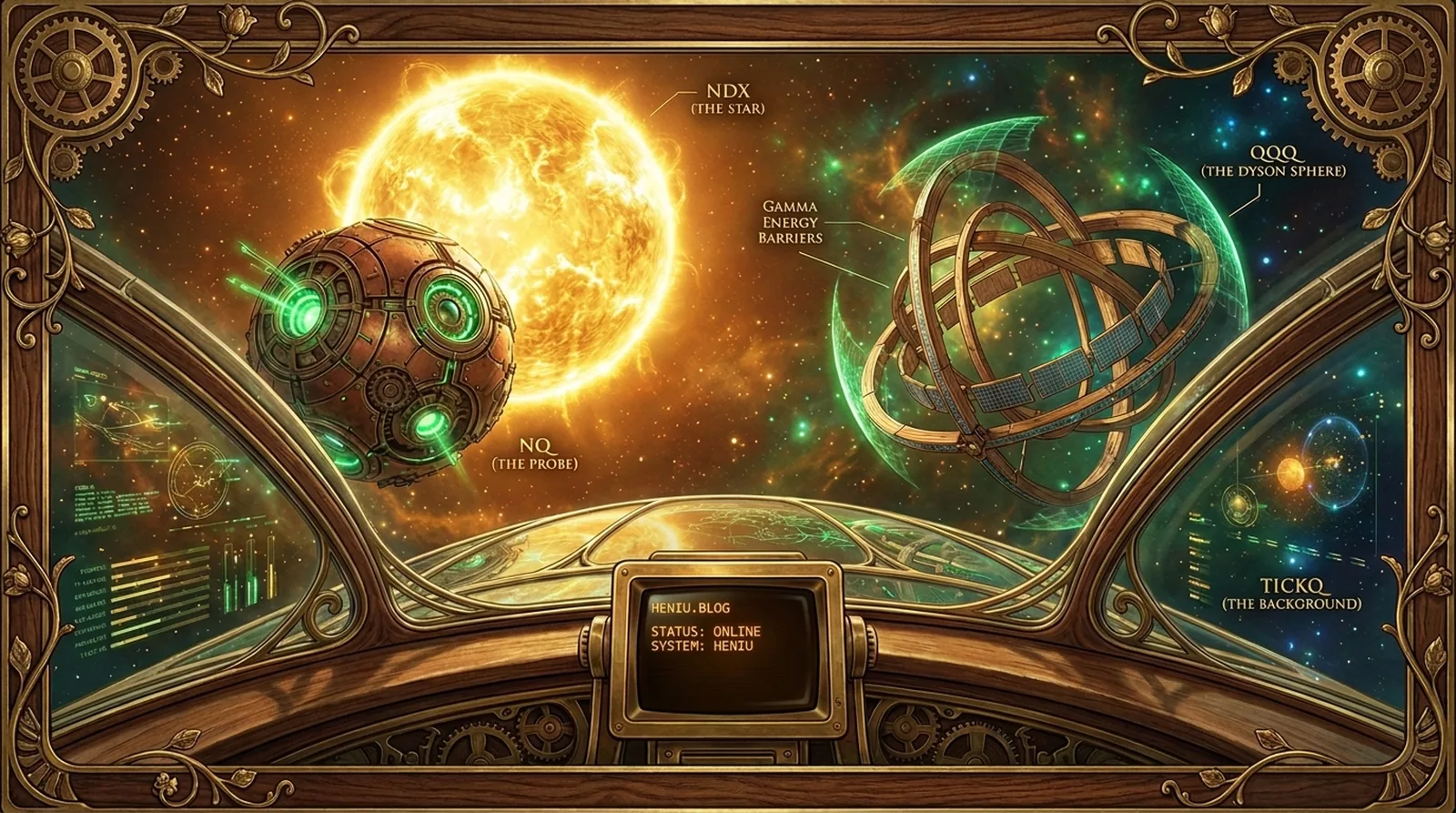
the NDX Star (Sun): Close: 29214.52 (-0.72%)
- Vector (CVD): −177,65 M [demand test]
- MOC Anomaly: +19,03 M
- Range Consumption (ADR Util): 68.15%
the NQ Probe (Mercury): Close: 29319.00 (-0.66%)
- Vector (CVD): −14,52 K [demand test]
- Range Consumption (ADR Util): 99.62%
the Dyson Sphere (QQQ): Close: 710.95 (-0.72%)
- Population Vector: −1,66 M [demand test]
- Range Consumption (ADR Util): 68.01%
Background Radiation (TICKQ) 148.00 [accumulation]:
- SMA200: -22.16 [sell-off]
Gravitational Structure (Options):
- Implied Volatility (IV): 20.29%%
- Put/Call OI: 1.20
Logbook: Cycle Analysis 2026.08.20#
1. Mass Redistribution and Fuel Deficit The system recorded a coherent decline in density: the Central Star NDX lost 0.72%, which pulled down the NQ Probe (-0.66%) and the Dyson Sphere (QQQ) (-0.72%). Despite the price decline, fuel telemetry (CVD) shows a “demand test” state across all key objects: NDX (-177,65M), NQ (-14,52K), and QQQ (-1,66M). The lack of rapid energy loss suggests that the movement is not driven by a sudden implosion, but by a slow erosion of density while simultaneously searching for new accumulation levels.
2. Background Radiation and Average Radiation Analysis Background Radiation (TICKQ) oscillates at the 148.00 level, classifying the broad market state as “accumulation”. However, the average radiation (SMA 200) remains at -22.16, indicating an ongoing “sell-off” phase on a broader time scale. The divergence between current radiation and the average suggests an attempt to form a local bottom within the wider downward trend.
3. Core Stability and Energy Structure Fluctuations in the Core composition remain in a state of stagnation; no emergence of new singularities or collapse of existing Class 0 objects was recorded. The total system mass (T-Mass) is 41.02 Trillion USD. With implied volatility (IV) at the 20.29% level, energy shields (Gamma) currently show no signs of a supernova, confirming low process dynamics within the Dyson Sphere.
Quantum Verdict: The system is in a phase of slow compression with attempts at local stabilization. Price movement is the result of searching for a new equilibrium under low fuel pressure.
Status: EXTERNAL OBSERVATION. Shields active.
End of log.