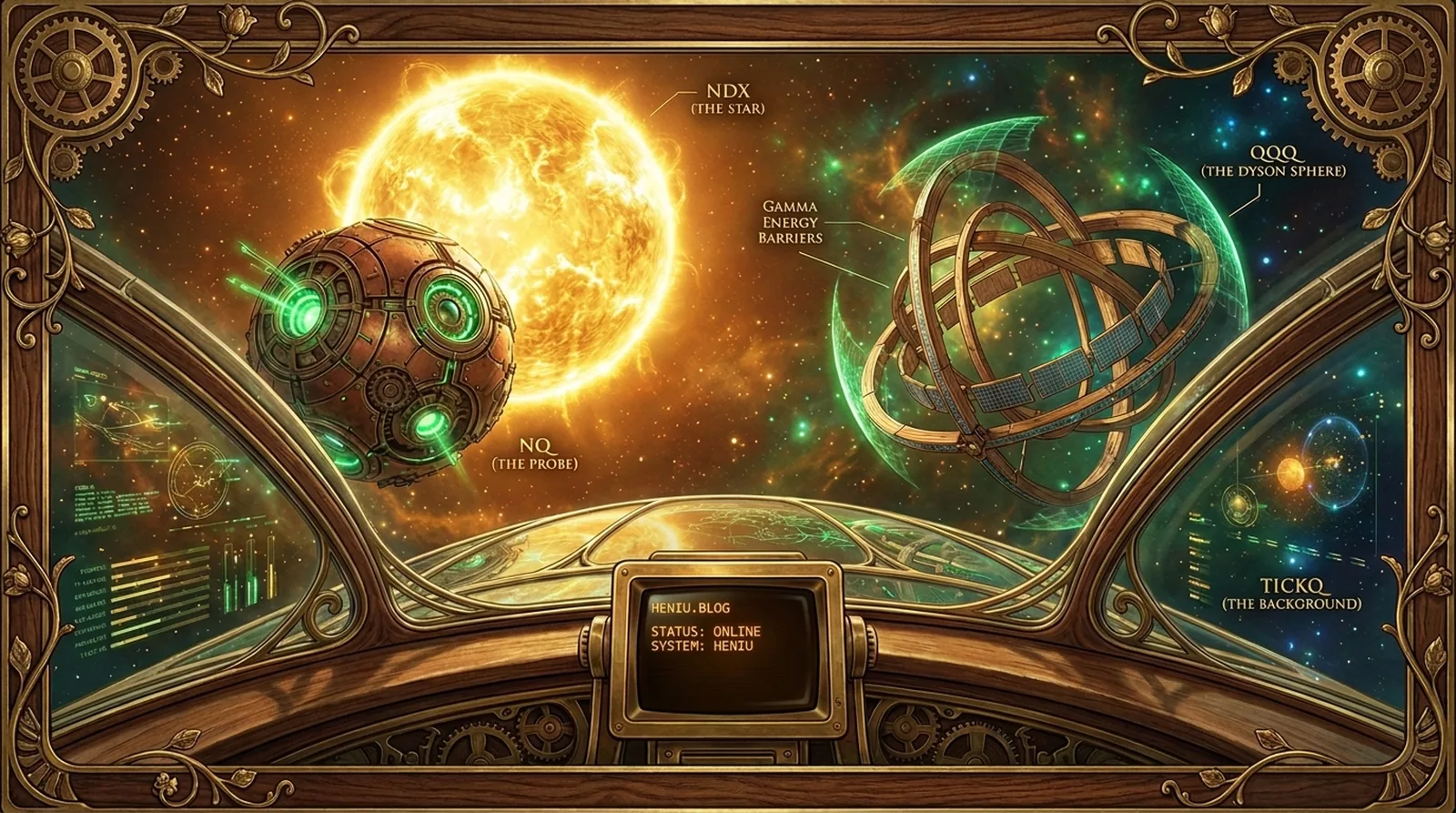

Log #0158: Tension in the Dyson Sphere (QQQ) and Divergent Radiation
Stardate: 2026.08.21 Systems Status: External Observation Sector: Inner Volatility Bands
Closing Telemetry#
The system shows nominal expansion with a simultaneous fuel deficit in the Mother Star, suggesting a mechanism driven by accumulation in orbital structures and high TICKQ radiation.
Subspace Scanner (Mass Distribution):
- System T-Mass: 41.18 Trillion USD
- Session Delta (24h): +0.16 Trillion USD
- Core Density (Heavy Nine): 67.55% (Delta: +0.03%)
- Average Action (Periphery Temperature): $297.27 (Delta: +$1.35)
the NDX Star (Sun): Close: 29309.25 (+0.33%)
- Vector (CVD): −107,8 M [demand test]
- MOC Anomaly: -7,85 M
- Range Consumption (ADR Util): 74.08%
the NQ Probe (Mercury): Close: 29381.25 (+0.28%)
- Vector (CVD): 10,07 K [accumulation]
- Range Consumption (ADR Util): 66.81%
the Dyson Sphere (QQQ): Close: 713.41 (+0.35%)
- Population Vector: 1,59 M [accumulation]
- Range Consumption (ADR Util): 73.77%
Background Radiation (TICKQ) 457.00 [market blast]:
- SMA200: -22.75 [sell-off]
Gravitational Structure (Options):
- Implied Volatility (IV): 19.31%%
- Put/Call OI: 1.22
Logbook: Cycle Analysis 2026.08.21#
1. Gravitational and Fuel Divergence An increase in the system’s nominal energy is observed: the NDX Star rose by 0.33%, the NQ Probe by 0.28%, and the Dyson Sphere (QQQ) by 0.35%. However, an anomalous fuel flow (CVD) structure exists. While the NQ Probe is in an accumulation phase (10.07k) and the Dyson Sphere (QQQ) shows accumulation (1.59M), the NDX Mother Star shows a demand test state with a fuel deficit (-107.8M). This suggests that the current price expansion is not driven by the central singularity, but by a shift of mass and energy toward orbital structures and the reconnaissance probe.
2. Radiation and Background Radiation A sharp increase in background radiation has been detected. The TICKQ indicator reached the 457.00 level, classifying the broad market state as a “market blast.” Simultaneously, the Average Radiation (TICKQ SMA 200) remains at -22.75, indicating an ongoing sell-off phase in the long-term view. This divergence between high, immediate radiation and negative average radiation indicates a sharp, but potentially unsustainable, energy impulse within the system.
3. Core Stability and System Mass The total system mass (T-Mass) is 41.18 Trillion USD. The Core composition fluctuation remains at a stable level; the absence of new emergences or class 0 singularity collapses (above 1T USD) means that central gravity is not currently undergoing rapid reconfigurations, allowing for the stabilization of current orbits despite fuel fluctuations.
Quantum Verdict: The system is in a phase of artificial compression with strong short-term radiation; increases are supported by accumulation in the Dyson Sphere, despite a fuel deficit in the gravitational center.
Status: EXTERNAL OBSERVATION. Shields active.
End of log.