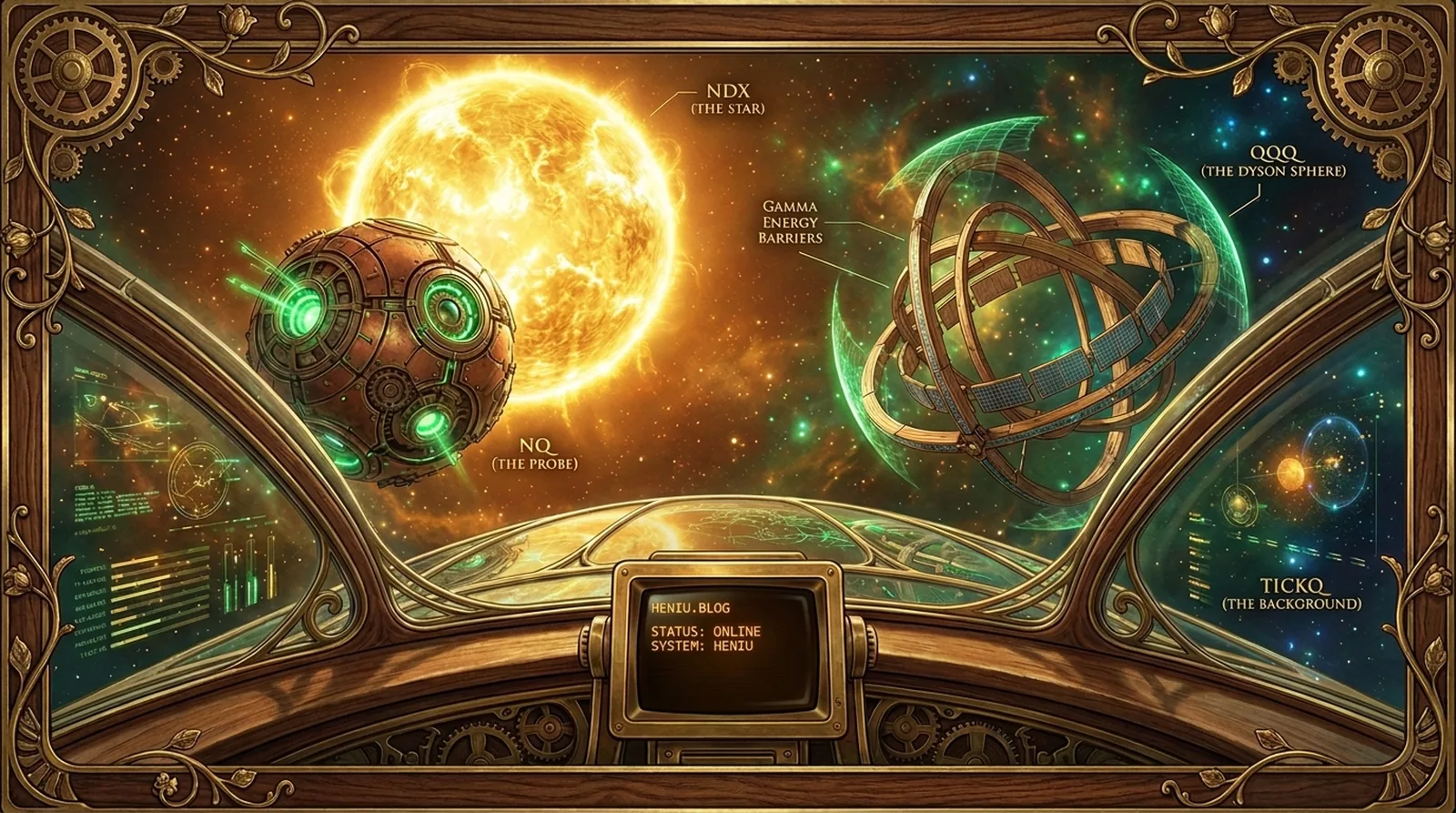

Log #0159: Accretion in the Shadow of a Sell-off
Stardate: 2026.08.23 System Status: External Observation Sector: Inner Volatility Bands
Weekly Close Telemetry#
The system is in a state of paradoxical price expansion with a simultaneous fuel deficit in the center of mass. High TICKQ radiation suggests a rapid energy flow that is not fully reflected in the Mother Star’s CVD structure.
Subspace Scanner (Mass Distribution):
- System T-Mass: 41.17 Trillion USD
- Weekly Delta: -0.02 Trillion USD
- Core Density (Heavy Nine): 67.53% (Delta: -0.01%)
- Average Action (Periphery Temperature): $311.08 (Delta: +$31.34)
the NDX Star (Sun): Close: 29311.40 (+0.33%)
- Vector (CVD): −107,8 M [demand test]
- MOC Anomaly: [NO DATA]
- Range Consumption (ADR Util): 74.08%
the NQ Probe (Mercury): Close: 29374.00 (+0.30%)
- Vector (CVD): 10,75 K [accumulation]
- Range Consumption (ADR Util): 66.81%
the Dyson Sphere (QQQ): Close: 713.41 (+0.35%)
- Population Vector: 1,59 M [accumulation]
- Range Consumption (ADR Util): 73.77%
Background Radiation (TICKQ) 542.00 [market burst]:
- SMA200: -20.99 [sell-off]
Gravitational Structure (Options):
- Implied Volatility (IV): 19.72%%
- Put/Call OI: 1.22
Logbook: Weekly Report (Stardate 2026.08.23)#
1. Gravitational and Fuel Divergence An increase in the system’s nominal energy is observed: NDX (+0.33%), NQ (+0.30%), and QQQ (+0.35%). Despite this expansion, the Mother Star (NDX) shows a fuel deficit characterized as a “demand test” (CVD: -107,8M), indicating a lack of strong accretion in the center of mass itself. Simultaneously, the NQ Probe has entered an accumulation phase (CVD: 10,75K), and the QQQ Dyson Sphere shows stable energy accumulation (CVD: 1,59M). The system mechanics suggest that price increases are not driven by a massive influx of fuel into the NDX, but by local absorption in the outer layers (Probe and Sphere).
2. Background Radiation Anomaly A strong divergence exists between current radiation and the system’s average radiation. TICKQ reached the 542.00 level, classifying the state as a “market burst” — a rapid dominance of upticks across a wide spectrum. However, the SMA 200 oscillates at the -20.99 level, indicating a persistent, structural “sell-off” phase in the long term. This disproportion suggests that the current burst of energy is a short-term phenomenon attempting to break the negative entropy of the average radiation.
3. Singularity Stability and System Mass The total system mass (T-Mass) remains at 41.17 Trillion USD. Monitoring the Core composition showed no gravitational fluctuations; all Class 0 objects remain in a stable orbit, preventing sudden shifts in the density of the entire system. The absence of new singularities or the collapse of existing ones allows for the maintenance of the current orbital geometry despite the instability in TICKQ radiation.
Quantum Verdict: The system is in a phase of artificial compression — prices are rising despite the fuel deficit in the center of mass, supported by local accumulation in the outer layers and a rapid, yet inconsistent with the long-term trend, burst of TICKQ radiation.
Status: EXTERNAL OBSERVATION. Shields active.
End of log.