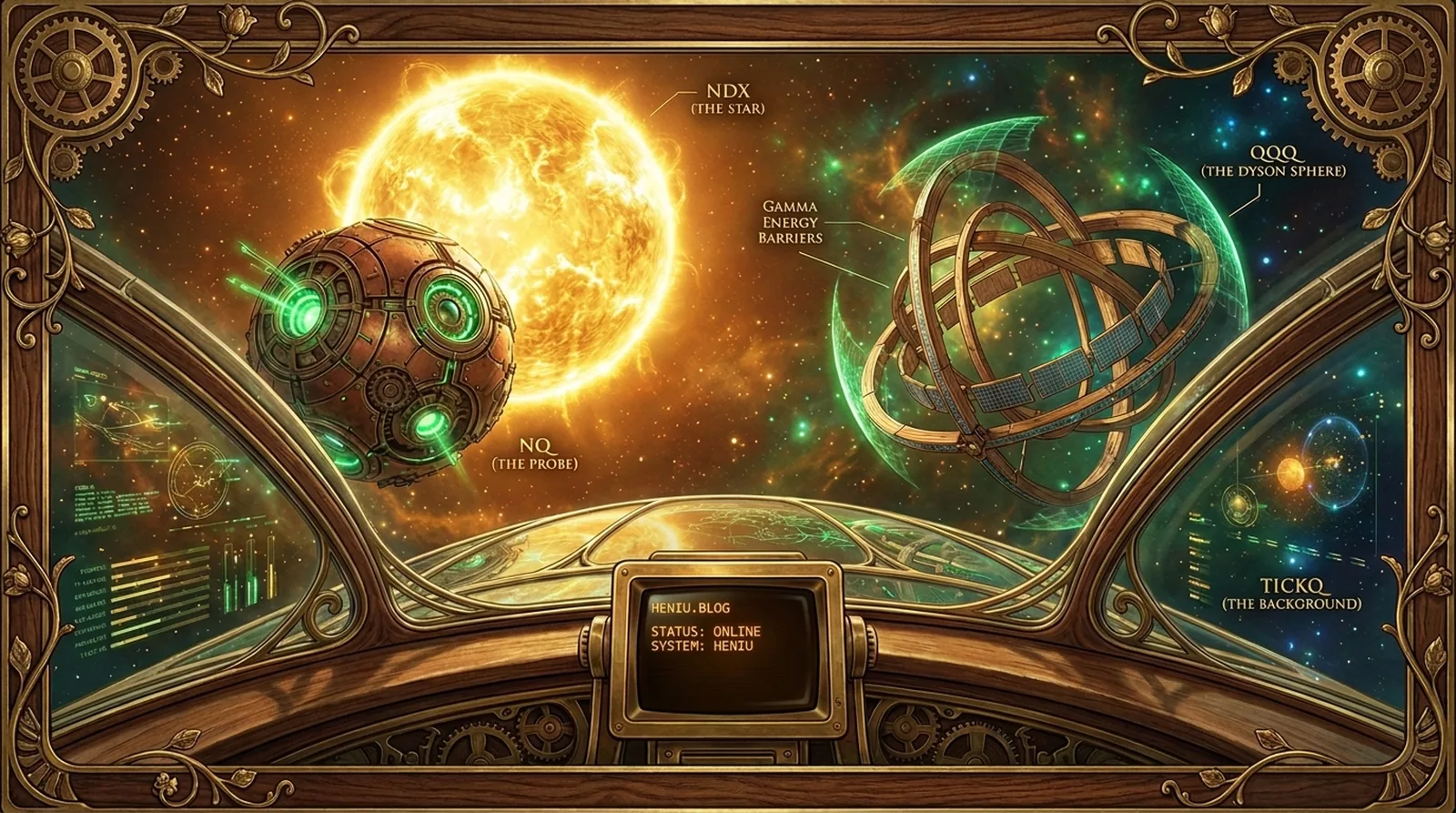

Log #0161: Burst Radiation and Force Field Stabilization
Stardate: 2026.08.25 Systems Status: External Observation Sector: Inner Volatility Bands
Closing Telemetry#
The system is in an expansion phase driven by strong TICKQ Background Radiation, while simultaneously experiencing low CVD fuel pressure, indicating a mechanical asymmetry between price dynamics and energy flow.
Subspace Scanner (Mass Distribution):
- System T-Mass: 41.13 Trillion USD
- Session Delta (24h): +0.27 Trillion USD
- Core Density (Heavy Nine): 67.61% (Delta: +0.06%)
- Average Action (Periphery Temperature): $258.04 (Delta: $-28.75)
the NDX Star (Sun): Close: 29202.70 (+0.64%)
- Vector (CVD): −99,21 M [demand test]
- MOC Anomaly: -11,81 M
- Range Consumption (ADR Util): 88.37%
the NQ Probe (Mercury): Close: 29274.00 (+0.58%)
- Vector (CVD): 2,88 K [demand test]
- Range Consumption (ADR Util): 99.31%
the Dyson Sphere (QQQ): Close: 710.63 (+0.61%)
- Population Vector: −454,38 K [demand test]
- Range Consumption (ADR Util): 90.03%
Background Radiation (TICKQ) 415.00 [market shot]:
- SMA200: 5.01 [demand test]
Gravitational Structure (Options):
- Implied Volatility (IV): 19.31%%
- Put/Call OI: 1.21
Logbook: Daily System Observation#
1. Kinetic Expansion and Fuel Deficit An increase in the density of the entire system is observed: the Mother Star NDX increased its radius by 0.64%, the NQ Probe by 0.58%, and the Dyson Sphere (QQQ) by 0.61%. Despite this expansion, fuel telemetry (CVD) shows a “demand test” state at all levels: NDX (-99,21M), NQ (2,88K), and QQQ (-454,38K). A mechanical divergence phenomenon is occurring here—price movement is taking place under low fuel pressure, suggesting that the current trajectory is being sustained by low supply absorption or the utilization of existing inertia, rather than fresh accretion from the Liquidity Nebula.
2. High Background Radiation and Core Stability Background Radiation (TICKQ) reached the level of 415.00, classifying the system state as a “market shot.” Average radiation (SMA 200) remains at 5.01, confirming the “demand test” phase. Strong, positive TICKQ radiation indicates the dominance of upticks in the microstructure, which serves as the primary engine of the current movement. Simultaneously, the Core composition (>1T) remains stable; the lack of gravitational fluctuations within the singularity ensures a constant mass reference for the entire system.
3. Field Structure and Total Mass The total mass of the system (T-Mass) oscillates around 41.13 Trillion USD. With volatility (IV) at the level of 19.31%, energy shields (Gamma) currently show no signs of rapid compression. The system is moving in a high-radiation regime, but with low intensity of CVD energy flow, creating a state of tension between directional dynamics and a deficit of real propulsion.
Quantum Verdict: The system is in an expansion phase driven by background radiation, with a simultaneous lack of strong support from the energy flow (CVD).
Status: EXTERNAL OBSERVATION. Shields active.
End of log.