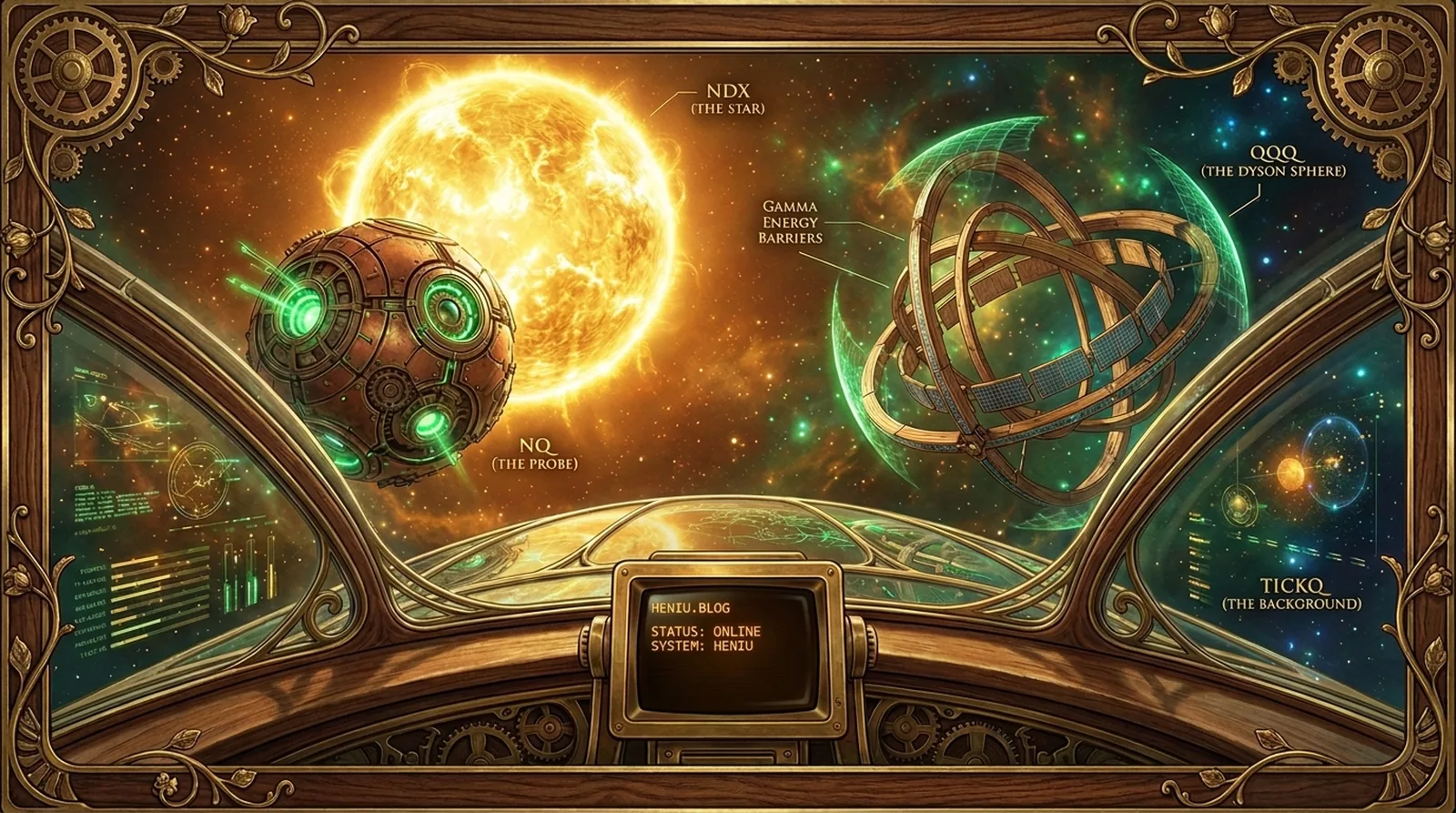

Log #0162: Force Field Stabilization in the Glow of Euphoria
Stardate: 2026.08.26 Systems Status: External Observation Sector: Inner Volatility Bands
Closing Telemetry#
The system is in a state of high gravitational stability with a simultaneous increase in TICKQ radiation, signaling a coherent expansion of energy throughout the sector.
Subspace Scanner (Mass Distribution):
- System T-Mass: 41.12 Trillion USD
- Session Delta (24h): -0.02 Trillion USD
- Core Density (Heavy Nine): 67.54% (Delta: -0.07%)
- Average Action (Periphery Temperature): $310.96 (Delta: +$39.35)
the NDX Star (Sun): Close: 29229.62 (+0.05%)
- Vector (CVD): 134,26 M [euphoria]
- MOC Anomaly: +116,72 M
- Range Consumption (ADR Util): 71.44%
the NQ Probe (Mercury): Close: 29326.00 (+0.17%)
- Vector (CVD): 10,04 K [accumulation]
- Range Consumption (ADR Util): 67.73%
the Dyson Sphere (QQQ): Close: 711.29 (+0.09%)
- Population Vector: 773,85 K [demand test]
- Range Consumption (ADR Util): 72.56%
Background Radiation (TICKQ) 221.00 [market blast]:
- SMA200: 15.29 [demand test]
Gravitational Structure (Options):
- Implied Volatility (IV): 18.99%%
- Put/Call OI: 1.20
Logbook: Cycle Observation 2026.08.26#
1. Stabilization of the Central Star and Reconnaissance Probe The main object of the system, NDX, maintains an almost unchanging mass (+0.05%), but generates intense fuel radiation (CVD at the level of 134,26M), which classifies the state of the Mother Star as euphoria. This energy surplus translates into the microstructure of the NQ Probe, which recorded an increase of 0.17% while simultaneously entering a fuel accumulation phase (CVD: 10,04K). The mechanics of flows indicate movement powered by high capital density, with a simultaneous lack of violent turbulence in the cash session layer.
2. Background Radiation and the State of the Dyson Sphere Background Radiation (TICKQ) reached the level of 221.00, which signifies a market blast and high dominance of positive uptick radiation. Average radiation (TICKQ SMA 200) oscillates around 15.29, keeping the system in a demand test phase. the Dyson Sphere (QQQ) shows marginal expansion (+0.09%), and its internal fuel pressure (CVD: 773,85K) is in the demand test zone, suggesting that energy shields are currently being stabilized by incoming energy units, showing no signs of overload.
3. Core Architecture and Total Mass The total mass of the system (T-Mass) is 41.12 Trillion USD. The Core Monitor detected no fluctuations in the composition of a class 0 singularity; the gravity of objects above 1T USD remains constant, preventing uncontrolled shifts in the density of the entire system. The lack of emergence of new singularities, combined with the increase in TICKQ radiation, creates an environment of low entropy and high mechanical predictability.
Quantum Verdict: The system is in a phase of stable expansion, driven by a fuel surplus in the Central Star and strong positive radiation in the broad market.
Status: EXTERNAL OBSERVATION. Shields active.
End of log.