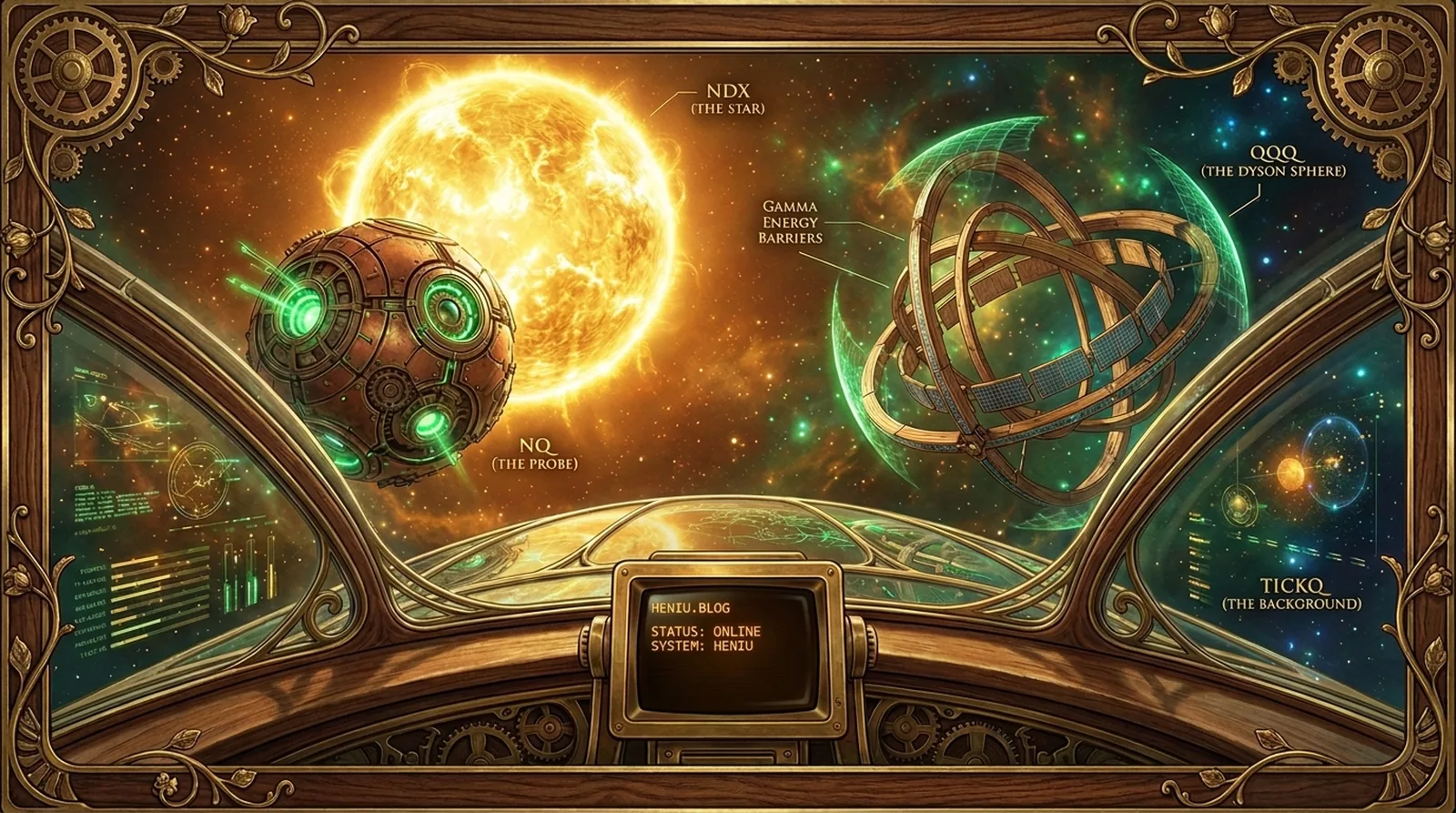

Log #0166: Stabilization in a low gravity field
Stardate: 2026.08.31 Systems Status: External Observation Sector: Inner Volatility Bands
Closing Telemetry#
System observation indicates a low energy state and testing of demand thresholds with a stable Core composition. Background Radiation suggests slow accretion under conditions of a lack of violent fluctuations.
Subspace Scanner (Mass Distribution):
- System T-Mass: 41.63 Trillion USD
- Session Delta (24h): +0.00 Trillion USD
- Core Density (Heavy Nine): 68.14% (Delta: +0.00%)
- Average Action (Periphery Temperature): $294.40 (Delta: +$0.00)
the NDX Star (Sun): Close: 29448.10 (+0.08%)
- Vector (CVD): −67,61 M [demand test]
- MOC Anomaly: -23,33 M
- Range Consumption (ADR Util): 65.32%
the NQ Probe (Mercury): Close: 29521.25 (+0.10%)
- Vector (CVD): −582 [demand test]
- Range Consumption (ADR Util): 69.10%
the Dyson Sphere (QQQ): Close: 716.82 (+0.04%)
- Population Vector: 890,43 K [demand test]
- Range Consumption (ADR Util): 64.43%
Background Radiation (TICKQ) 77.00 [accumulation]:
- SMA200: 31.80 [accumulation]
Gravitational Structure (Options):
- Implied Volatility (IV): 17.69%%
- Put/Call OI: 1.24
Logbook: Daily Observational Report#
1. Stabilization of the Central Star and Probe the NDX Star shows minimal expansion (+0.08%) with energy flow (CVD) at a level of -67,61M, classifying the state as a demand test. the NQ Probe moves in correlation (+0.10%), exhibiting an almost neutral energy flow (-582), which confirms the lack of violent turbulence in the warp drive. The system is in a low dynamics phase, where price drifts along the neutral axis.
2. Background Radiation and the Dyson Sphere TICKQ Background Radiation (77.00) and average SMA200 radiation (31.80) indicate a state of accumulation in the broad sector. the Dyson Sphere (QQQ) maintains force field stability with a minimal increase (+0.04%) and positive energy flow (890,43K), confirming a demand test in the options structure. This stability is supported by the lack of fluctuations in the Core composition (>1T), meaning that singularities remain intact.
3. Analysis of System Mass and Energy The total system mass (T-Mass) is 41.63 Trillion USD with IV volatility at the level of 17.69%. The lack of emergence of new singularities and the lack of collapse of existing Class 0 objects stabilizes the event horizon. The system operates in a low entropy regime, preparing for potential accretion or further testing of supply/demand thresholds.
Quantum Verdict: The system is in a state of stagnation of an accumulative nature. Flow mechanics indicate testing the stability of demand thresholds while simultaneously maintaining the structural integrity of the Core.
Status: EXTERNAL OBSERVATION. Shields active.
End of log.