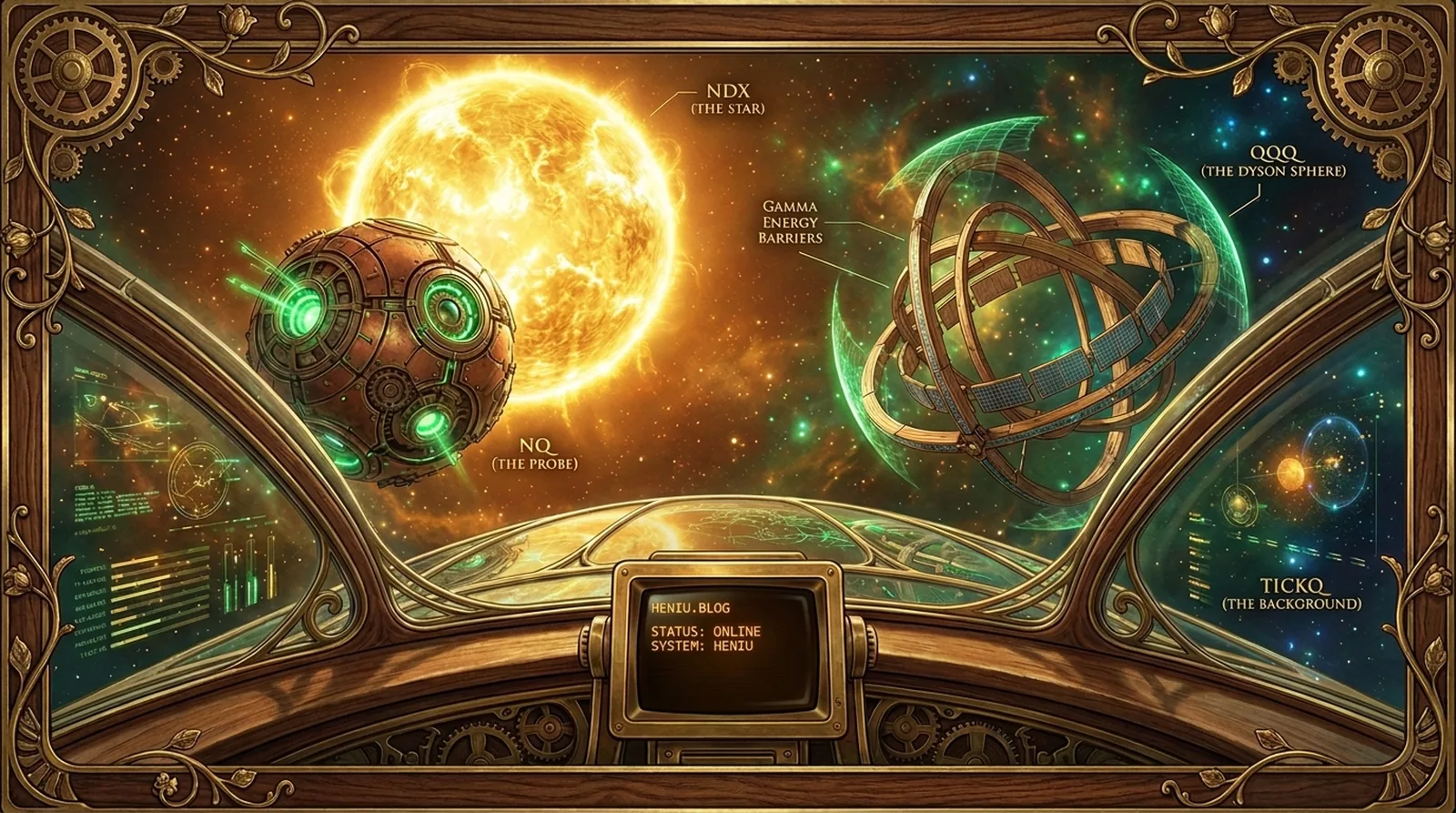

Log #0167: Attempt at stabilization in the shadow of falling gravity
Stardate: 2026.09.01 System Status: External Observation Sector: Inner Volatility Bands
Closing Telemetry#
Observation of a decrease in the system’s energetic value accompanied by the simultaneous detection of signals testing demand thresholds. The system is in a phase of seeking a new equilibrium point after the impact of a supply wave.
Subspace Scanner (Mass Distribution):
- System T-Mass: 41.20 Trillion USD
- Session Delta (24h): -0.43 Trillion USD
- Core Density (Heavy Nine): 68.31% (Delta: +0.17%)
- Average Action (Periphery Temperature): $293.60 (Delta: $-0.80)
the NDX Star (Sun): Close: 29037.35 (-1.42%)
- Vector (CVD): −6,66 M [demand test]
- MOC Anomaly: [NO DATA]
- Range Consumption (ADR Util): 117.40%
the NQ Probe (Mercury): Close: 29091.50 (-1.43%)
- Vector (CVD): −6,6 K [demand test]
- Range Consumption (ADR Util): 146.34%
the Dyson Sphere (QQQ): Close: 706.76 (-1.40%)
- Population Vector: −459,3 K [demand test]
- Range Consumption (ADR Util): 115.41%
Background Radiation (TICKQ) -402.00 [market breakdown]:
- SMA200: 4.08 [demand test]
Gravitational Structure (Options):
- Implied Volatility (IV): 18.57%%
- Put/Call OI: 1.33
Logbook: Observation Report for cycle 2026.09.01#
1. Energy drop in the Central Star and the Reconnaissance Probe the NDX Star recorded a decrease of 1.42%, which, with energy flow (CVD) at the level of -6.66M, classifies the current state as a demand test. A similar trajectory is shown by the NQ Probe, losing 1.43% of its value with CVD amounting to -6.6K (demand test). Flow mechanics indicate the fading of accretion and an attempt to establish a new orbit after a sudden outflow of mass.
2. Background radiation and the state of the Dyson Sphere Background Radiation (TICKQ) reached the level of -402.00, signaling a market breakdown across a broad spectrum. At the same time, average radiation (SMA200) remains at the level of 4.08, indicating a demand test in long-term radiation. the Dyson Sphere (QQQ) shrank by 1.40%, and its internal energy flow (CVD: -459.3K) confirms a phase of testing supply within the energy shield structure.
3. Core stability and system mass Despite the drop in nominal values, the Core composition fluctuation (>1T) shows full stability — no emergence or collapse of key singularities. The total system mass (T-Mass) is 41.20 Trillion USD. The absence of anomalies in the Class 0 structure suggests that the current fluctuations are a result of fluctuations in the gaseous layers, rather than a destabilization of gravitational fundamentals.
Quantum Verdict: The system is in a phase of orbital correction. Despite the breakdown in broad radiation (TICKQ), CVD indicators in all major objects (NDX, NQ, QQQ) indicate testing of demand thresholds, suggesting an attempt to absorb energy to prevent further degradation.
Status: EXTERNAL OBSERVATION. Shields active.
End of log.