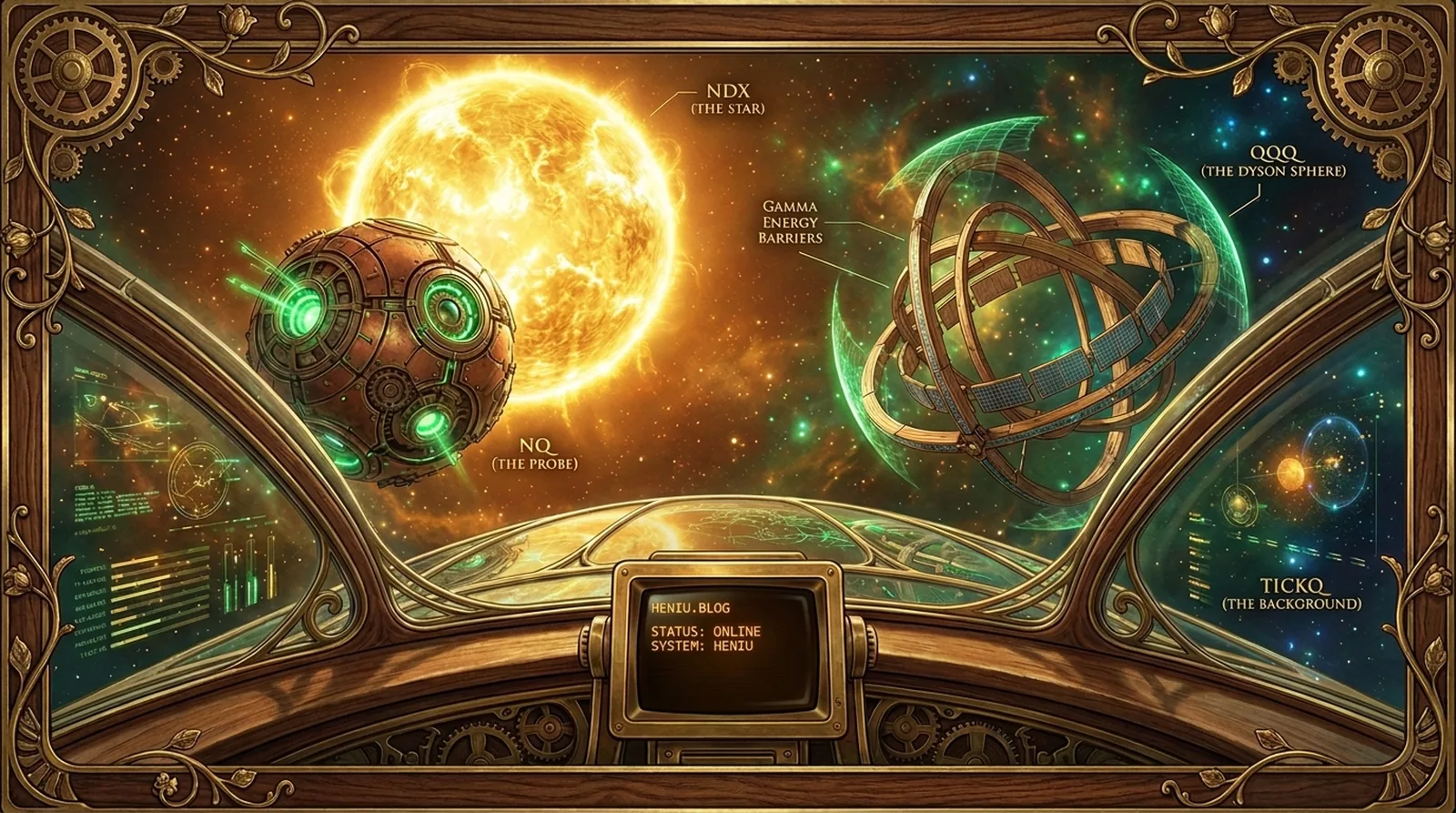

Log #0169: Expansion of the Dyson Sphere and Accretion in the Center of Mass
Stardate: 2026.09.03 Systems Status: External Observation Sector: Inner Volatility Bands
Closing Telemetry#
Observation shows a rapid increase of energy in the system, driven by strong accretion in the Central Star and high broad market radiation. The stability of the Core allows for the unobstructed expansion of instrument orbits.
Subspace Scanner (Mass Distribution):
- System T-Mass: 41.98 Trillion USD
- Session Delta (24h): +0.64 Trillion USD
- Core Density (Heavy Nine): 68.81% (Delta: +0.27%)
- Average Action (Periphery Temperature): $290.04 (Delta: +$5.63)
the NDX Star (Sun): Close: 29483.37 (+1.16%)
- Vector (CVD): 216,84 M [euphoria]
- MOC Anomaly: +21,85 M
- Range Consumption (ADR Util): 143.79%
the NQ Probe (Mercury): Close: 29514.00 (+1.12%)
- Vector (CVD): 37,5 K [accumulation]
- Range Consumption (ADR Util): 131.27%
the Dyson Sphere (QQQ): Close: 717.61 (+1.19%)
- Population Vector: 2,23 M [market blast]
- Range Consumption (ADR Util): 142.28%
Background Radiation (TICKQ) 404.00 [market blast]:
- SMA200: 15.18 [demand test]
Gravitational Structure (Options):
- Implied Volatility (IV): 17.56%%
- Put/Call OI: 1.35
Logbook: Daily Observational Report#
1. Accretion in the Central Star the NDX Star shows a strong euphoria phase with energy flow (CVD) at the level of 216,84M. The price increase of 1.16% is correlated with the energetic mass, which stabilizes the trajectory of the entire system. the NQ Probe confirms this direction, being in an accumulation phase (CVD: 37,5K) with a price increase of 1.12%, indicating a consistent journey towards Price Discovery.
2. Broad Market Radiation and Sphere Stability the TICKQ Background Radiation reached the level of 404,00, which classifies the state of the system as a market blast. The average radiation (SMA200) is 15,18, signaling a demand test. Simultaneously, the Dyson Sphere (QQQ) shows a powerful energy emission (CVD: 2,23M), which translates into a market blast and a price increase of 1.19%, strengthening the structural shields of the system.
3. Core Composition Stability and System Mass Monitoring the Core (>1T) showed no anomalies; the absence of emergence or a class 0 singularity collapse ensures constant gravity for the remaining objects. The total system mass (T-Mass) is 41,98 Trillion USD, which, given the current volatility (IV: 17,56%), creates a stable environment for further energetic expansion without the risk of a sudden collapse of the orbital structure.
Quantum Verdict: The system is in a phase of strong, coordinated expansion. High accretion in the center and support from the broad market (TICKQ) are building a coherent force field.
Status: EXTERNAL OBSERVATION. Shields active.
End of log.