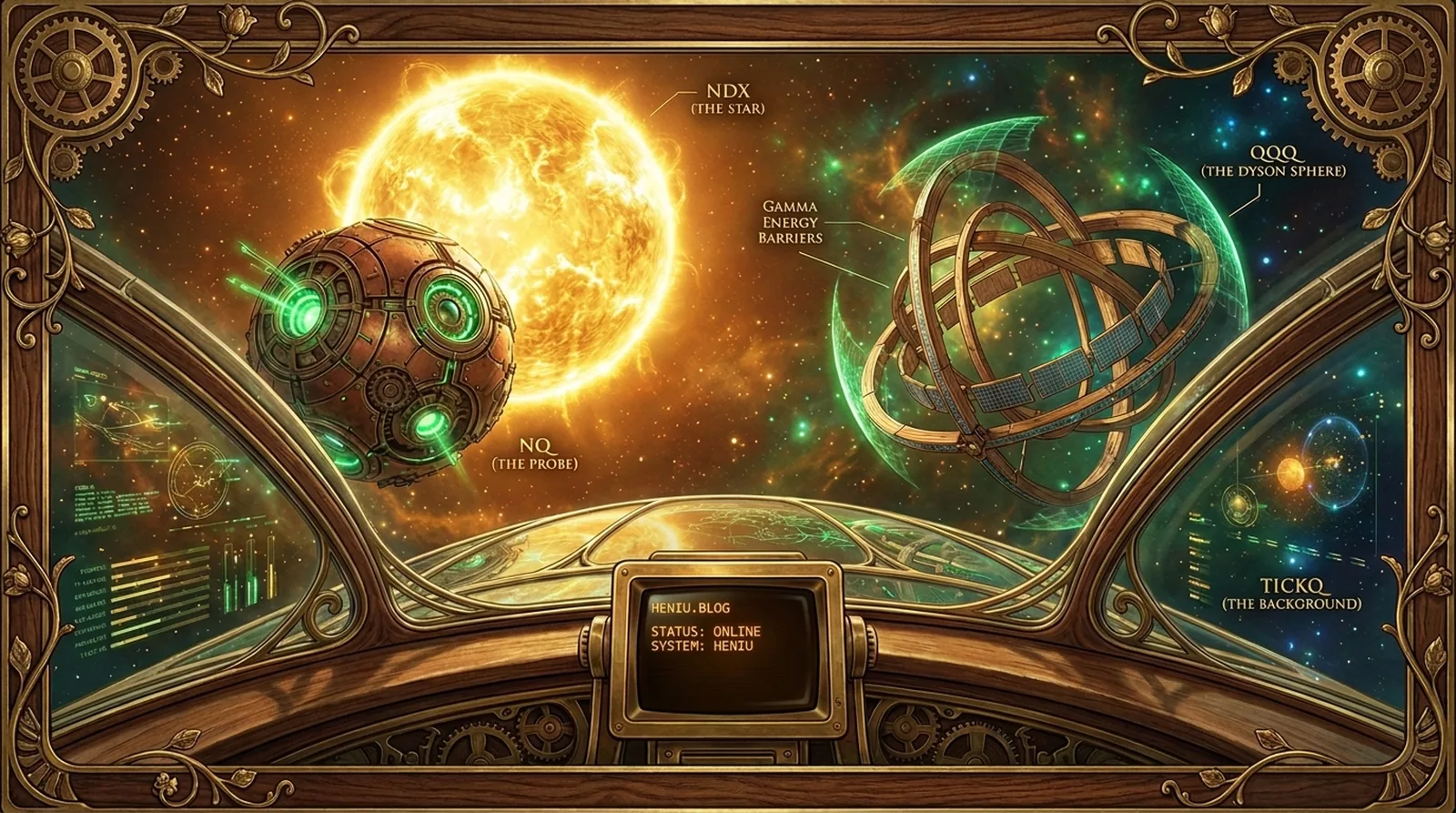

Log #0170: Accretion in the Euphoria area: Force Field Stabilization
Stardate: 2026.09.04 Systems Status: External Observation Sector: Inner Volatility Bands
Closing Telemetry#
Observation showed a sudden increase in energy in the Central Star while simultaneously maintaining the structural integrity of the Dyson Sphere. The system is in an accretion phase, driven by strong flows in the NDX sector.
Subspace Scanner (Mass Distribution):
- System T-Mass: 41.86 Trillion USD
- Session Delta (24h): -0.12 Trillion USD
- Core Density (Heavy Nine): 68.43% (Delta: -0.37%)
- Average Action (Periphery Temperature): $277.52 (Delta: $-17.94)
the NDX Star (Sun): Close: 29542.65 (+0.21%)
- Vector (CVD): 157,91 M [euphoria]
- MOC Anomaly: +140,50 M
- Range Consumption (ADR Util): 79.01%
the NQ Probe (Mercury): Close: 29552.00 (+0.09%)
- Vector (CVD): 2,56 K [demand test]
- Range Consumption (ADR Util): 58.23%
the Dyson Sphere (QQQ): Close: 719.06 (+0.19%)
- Population Vector: 129,11 K [demand test]
- Range Consumption (ADR Util): 78.99%
Background Radiation (TICKQ) 571.00 [market blast]:
- SMA200: 16.93 [demand test]
Gravitational Structure (Options):
- Implied Volatility (IV): 17.43%%
- Put/Call OI: 1.36
Logbook: Daily Observational Report#
1. Central Star Energy Expansion the NDX Star exhibits a state of euphoria, generating an energy flow at the level of 157,91M. This sudden accretion of mass in the center of the system exerts a gravitational influence on the remaining objects, stabilizing the price at the level of 29542.65 (+0.21%). Despite dominance on the macro scale, the NQ Probe and the Dyson Sphere (QQQ) show only demand tests (CVD at 2,56K and 129,11K respectively), suggesting that energy from the Central Star has not yet fully permeated the smaller scout units and stabilizing structures.
2. Broad Market Radiation and Field Stability Background Radiation (TICKQ) reached the level of 571.00, classifying the phenomenon as a market blast. Average radiation (SMA200) holds at the level of 16.93, indicating a demand test within the broader cosmic structure. The absence of anomalies in the Core composition (>1T) confirms that Class 0 singularities maintain full stability, emitting no signals of an impending collapse nor creating new spacetime curvature points.
3. Dyson Sphere Dynamics and Flow Implications the Dyson Sphere (QQQ) (+0.19%) serves as a stabilizer, maintaining system integrity under increasing fuel pressure. Although IV oscillates around 17.43%, and the total T-Mass amounts to 41.86 Trillion USD, the system shows no signs of thermodynamic instability. Accumulated energy in NDX dominates local fluctuations, creating an environment conducive to further accretion within the current horizon.
Quantum Verdict: The system is in a phase of strong accretion driven by the Central Star, with a simultaneous lack of full impulse synchronization in the NQ Probe. The system is stable, with dominant “market blast” type radiation.
Status: EXTERNAL OBSERVATION. Shields active.
End of log.