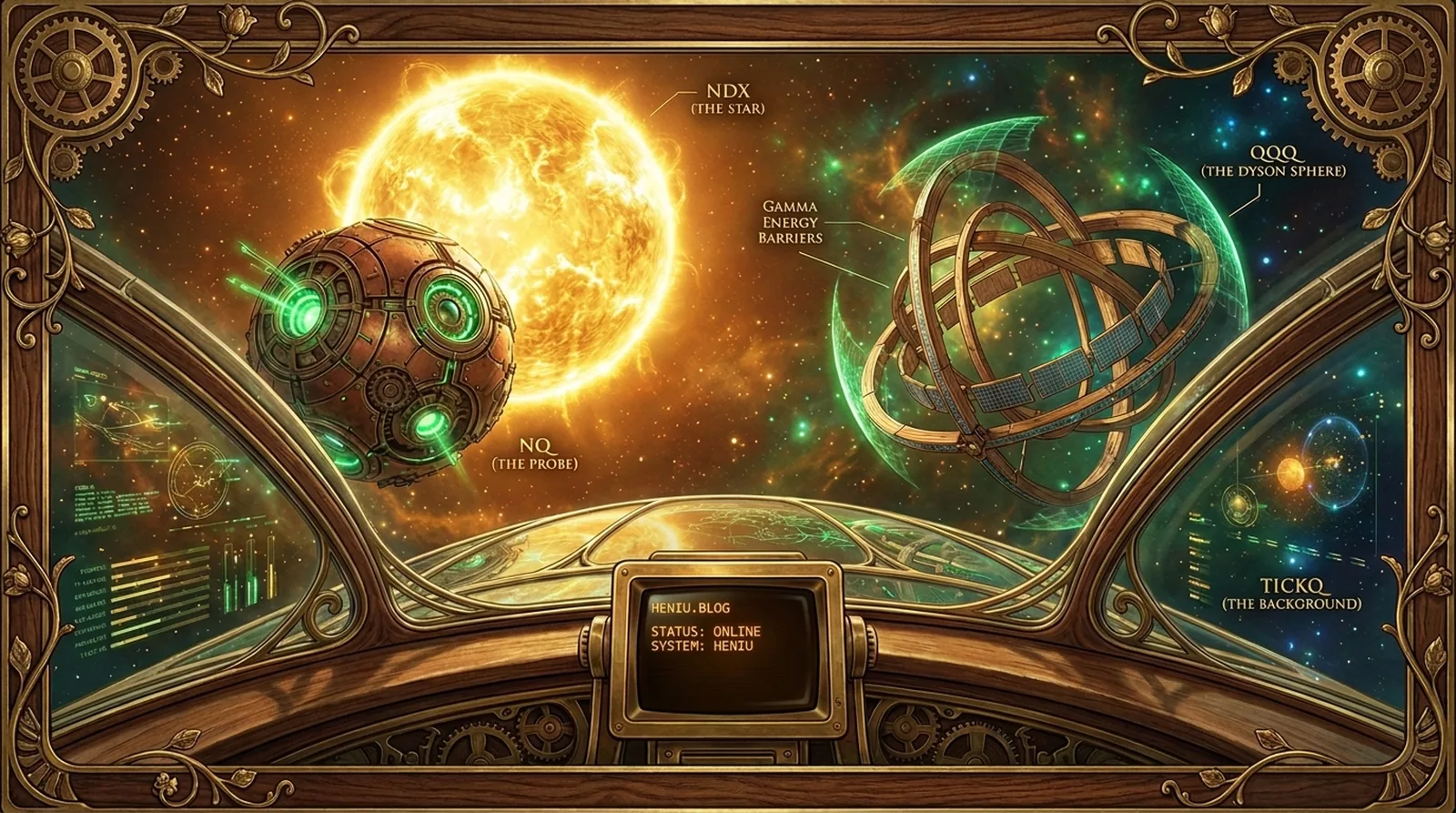

Log #0172: Silence before the Supernova: Dissonance in the Force Field
Stardate: 2026.09.08 Systems Status: External Observation Sector: Inner Volatility Bands
Closing Telemetry#
Observation showed a strong divergence between the stability of the Core and a sharp drop in TICKQ Background Radiation. The system is in a phase of testing supply thresholds while simultaneously accumulating energy in the Central Star.
Subspace Scanner (Mass Distribution):
- System T-Mass: 41.83 Trillion USD
- Session Delta (24h): -0.03 Trillion USD
- Core Density (Heavy Nine): 68.32% (Delta: -0.12%)
- Average Action (Periphery Temperature): $309.50 (Delta: +$4.22)
the NDX Star (Sun): Close: 29509.83 (-0.12%)
- Vector (CVD): 33,49 M [accumulation]
- MOC Anomaly: +0,00 M
- Range Consumption (ADR Util): 93.90%
the NQ Probe (Mercury): Close: 29514.75 (-0.17%)
- Vector (CVD): −26,1 K [demand test]
- Range Consumption (ADR Util): 84.49%
the Dyson Sphere (QQQ): Close: 718.38 (-0.08%)
- Population Vector: −1,04 M [demand test]
- Range Consumption (ADR Util): 94.19%
Background Radiation (TICKQ) -626.00 [panic]:
- SMA200: 9.14 [demand test]
Gravitational Structure (Options):
- Implied Volatility (IV): 18.73%%
- Put/Call OI: 1.38
Logbook: Cycle Analysis 2026.09.08#
1. Accretion in the Center of Mass the NDX Star shows features of accumulation with energy flow (CVD) at a level of 33.49M. Despite a nominal price drop of 0.12%, the flow mechanics indicate supply absorption. The Core composition (>1T) remains stable, meaning there is no collapse of key singularities in this cycle.
2. Radiation and destabilization of the Dyson Sphere A sharp spike in TICKQ Background Radiation to the level of -626 was detected, classifying the system state as panic. Simultaneously, the Dyson Sphere (QQQ) shows a demand test with negative CVD at a level of -1.04M, suggesting that the options structure is attempting to stabilize the force field in the face of liquidity escape. the NQ Probe confirms this state, performing a demand test (CVD: -26.1K).
3. Average Radiation Analysis The SMA200 for TICKQ oscillates around 9.14, which shifts the reading from the panic area toward a demand test in terms of the long-term average radiation. This indicates that although the local market fauna is in a state of panic, the global field structure has not yet undergone permanent degradation.
Quantum Verdict: The system is in a state of high local entropy (TICKQ panic) while simultaneously building foundations for new accretion in the Central Star. A test of the energy shield’s endurance is occurring.
Status: EXTERNAL OBSERVATION. Shields active.
End of log.