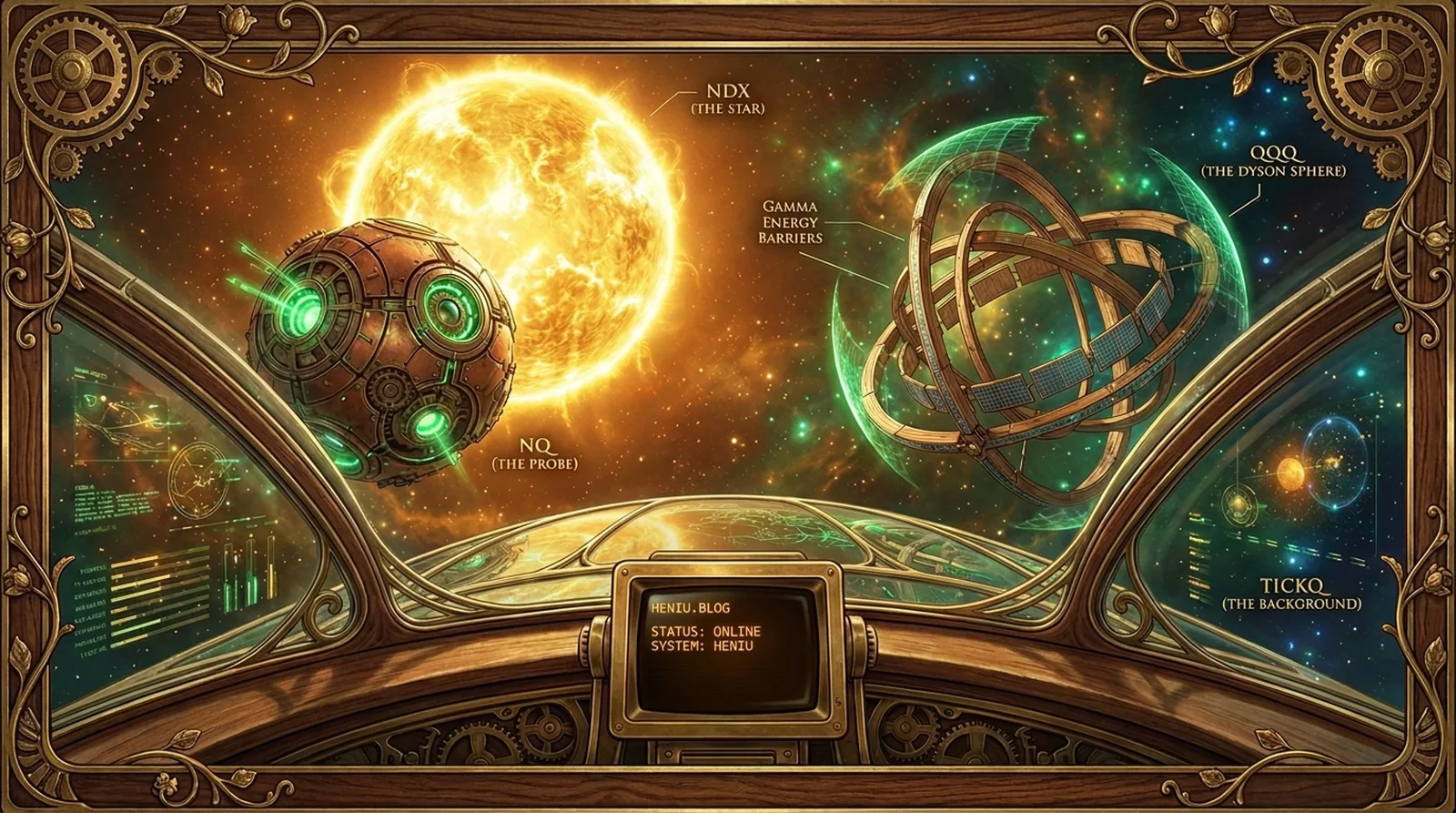

Log #0197: Phase shift: Energy collision and radiation divergence
⚠️ ERRATUM (2026-10-11)
No data for this session. Open powerlessness: that day Heniu did not see the galaxy. On Thursday 8 Oct not a single reading of the NDX constituents and market caps reached Heniu from the Nasdaq website. The report filled the gap with the last reading from Wednesday 7 Oct and labelled it as Thursday. The Nasdaq website published correct data. The link that brings it to Heniu failed.Withdrawn from this entry (8 Oct: no data):
- System T-Mass 44.07 Trillion USD and Session Delta −0.08: Wednesday’s values. That day the NDX Star fell 1.39%.
- Core Density 71.04% (Delta +0.14%) and Average Action $304.27 (Delta +$12.88).
- The phrase about a stable Core composition in the summary, point 3 of the log (“Gravitational stability and system mass”) and the part of the Verdict about Core stability. Core composition on 8 Oct: no data.
Prices, CVD and ADR of the NDX Star, the NQ Probe and the Dyson Sphere (QQQ), TICKQ and the options data come from other sources and remain valid.
Stardate: 2026.10.08 System Status: External Observation Sector: Inner Volatility Bands
Closing Telemetry#
The Central Star and the NQ Probe are experiencing a rapid drainage of fuel, while the broad market is emitting anomalously strong positive radiation. The system is in a state of high entropy with a stable Core composition.
Subspace Scanner (Mass Distribution):
- System T-Mass: 44.07 Trillion USD
- Session Delta (24h): -0.08 Trillion USD
- Core Density (Heavy Nine): 71.04% (Delta: +0.14%)
- Average Action (Periphery Temperature): $304.27 (Delta: +$12.88)
the NDX Star (Sun): Close: 30728.98 (-1.39%)
- Vector (CVD): −190,25 M [panic]
- MOC Anomaly: -18,88 M
- Range Consumption (ADR Util): 185.98%
the NQ Probe (Mercury): Close: 30996.75 (-1.29%)
- Vector (CVD): −41,22 K [market collapse]
- Range Consumption (ADR Util): 145.53%
the Dyson Sphere (QQQ): Close: 747.57 (-1.34%)
- Population Vector: −1,51 M [sell-off]
- Range Consumption (ADR Util): 182.59%
Background Radiation (TICKQ) 339.00 [market spike]:
- SMA200: -27.94 [sell-off]
Gravitational Structure (Options):
- Implied Volatility (IV): 18.89%%
- Put/Call OI: 1.47
Logbook: Daily system observation report#
1. Energy drainage in the center of mass the NDX Star recorded a decrease of 1.39%, and its energy flow (CVD) reached the level of -190.25M, which classifies the state as panic. the NQ Probe follows this movement with a negative change of 1.29% and fuel pressure at the level of -41.22K, signifying a market collapse in the futures session layer. the Dyson Sphere (QQQ) shows a sell-off at the level of -1.51M (CVD), confirming the destabilization of the orbital structure.
2. Anomalous broad market radiation A strong divergence was noted between the mechanics of the main objects and the background radiation. TICKQ indicates a market spike (339.00), which contradicts the downward trend of NDX and NQ. At the same time, the average radiation (SMA200) remains in the sell-off zone (-27.94), suggesting that the broad market impulse is a temporary disturbance within the broader context of the downward trend.
3. Gravitational stability and system mass Despite rapid price fluctuations and energy decrease, the system mass (T-Mass) remains at the level of 44.07 Trillion USD. The Core Monitor detected no anomalies – no fluctuation in the composition of class 0 objects occurred, meaning that despite panic in the flows, the gravitational fundamentals of the largest singularities remain intact.
Quantum Verdict: The system is in a state of strong divergence between the fuel drainage in the center (NDX/NQ) and the anomalous spike in broad market radiation (TICKQ). Flow mechanics indicate panic, but the stability of the Core prevents the collapse of the entire structure.
Status: EXTERNAL OBSERVATION. Shields active.
End of log.