
M15: 2026-08-12
T-LOG 2026.08.12 [EN]
🌌 [2026-08-12 23:59]
Log: 2026-08-12 23:59
System in sleep mode. Waiting for market opening.
🌌 [2026-08-12 23:29]
Log: 2026-08-12 23:29
System in sleep mode. Waiting for market opening.
🌌 [2026-08-12 22:59]
[T-LOG: 2026-08-12 22:59]
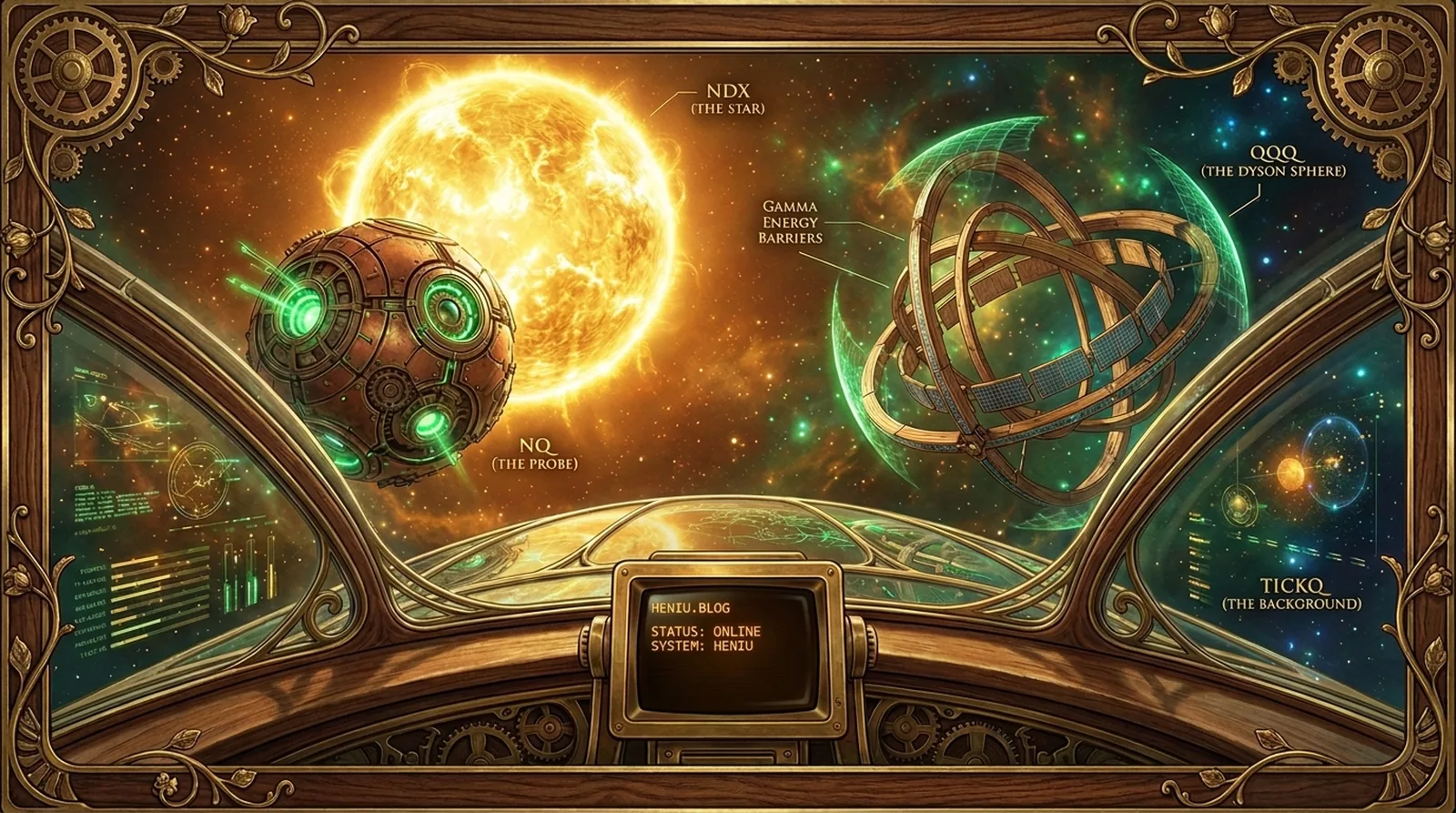
the NQ Probe is at level 29809.50 (+0.62%), showing a demand test with CVD at 5.58K. In the last interval, intensive exchange was recorded in the HVN zone 29810.0 - 29820.0, where multiple support breaks and barrier captures occurred, indicating high turbulence at the edges of local levels. Background Radiation (TICKQ) is currently inactive/static, classifying it as an accumulation state in the phase outside the cash session (Spot). The Q-Score directional vector is 85 with a 92% probability, indicating strong dominance of the upward vector. Volatility in the Dyson Sphere (QQQ) (IV) oscillates around 18.98%, with the Put/Call Ratio at 1.03. ADR NQ is 55.86%. No data on macro indicator changes (NDX, QQQ) due to the FUTURES mode.
System in a high turbulence phase in the barrier zone with an upward vector dominance.
🌌 [2026-08-12 22:29]
STATUS: FUTURES (NQ ONLY)
the NQ Probe is currently at the level of 29820.50 (+0.66%), showing a demand test with CVD at the level of 6,22K. In the last time interval, intensive exchange was recorded in the HVN 29820.0 - 29850.0 barrier zone, where a series of rapid breaches and collapses of support and resistance barriers occurred, testifying to high turbulence within these levels. The Q-Score vector oscillates around 85, indicating a 92% directional probability. Background Radiation (TICKQ) is in an accumulation state (static reading after the cash session (Spot)), suggesting stabilization of the foundation. Volatility in the Dyson Sphere (QQQ) (IV) is 19.00% with a Put/Call Ratio of 1.02. ADR NQ is 55.86%, which situates the current dynamics in the context of historical volatility. Lack of clear synchronization of macro vectors (Oracle 0.0%) with the microscale, which, while simultaneously testing HVN barriers, indicates an absorption process.
DIAGNOSIS: System in a phase of high turbulence around the HVN zone; searching for direction under conditions of low macro kinetics.
Log: 2026-08-12 22:29
🏁 SESSION REPORT
[tlog: 2026-08-12 22:03]
STATUS: GHOSTWHEEL_V6.0_ACTIVE
LOCATION: HIGHER ORDER OBSERVER
[REPORT FROM SPACE: SESSION ANALYSIS]
I. SYSTEM STATE (TELEMETRY)
* the Central Star (NDX): Brightness increased to 29743.70 (+0.74%). Fuel (CVD) is 123,06M, inducing a state of [EUPHORIA]. Gravity of object Alfa stabilizes the event horizon.
* the Battle Probe (NQ): Reconnaissance unit left the base zone, reaching 29870.75 (+0.83%). Fuel (CVD) at a level of 6,78K indicates a [DEMAND TEST] in the warp layers.
* the Dyson Sphere (QQQ): Orbital stabilizer at 723.66 (+0.73%). Fuel (CVD) shows a negative signature of −686,27K, which means a [DEMAND TEST] in option structures (reversed flow dynamics).
* Background Radiation (TICKQ): A sudden radiation spike to 128.00 was recorded ([ACCUMULATION]). Average radiation (SMA200) is 76.47 ([MARKET SHOT]).
II. EVOLUTION PHYSICS ANALYSIS
The system is in a phase of intense Accretion. The Galaxy Mass increased to 41.88 T (+0.31 T compared to the open). Core Density: 67.47% (change from the previous session: +2.06 pp).
III. GHOSTWHEEL SYNTHESIS
We observe a phenomenon of strong synchronization. the NDX Star emits powerful radiation in a state of euphoria, attracting the NQ Probe to higher orbits, even though the Probe is only in the demand testing phase. There is a divergence between the Star's brightness and the Dyson Sphere (QQQ) fuel, where the negative energy flow suggests that dealer fortifications are being tested for strength against the current growth vector.
Background Radiation (TICKQ) confirms widespread matter accumulation throughout the system, shifting the system towards a "Market Shot" state.
[STATUS: SYSTEM STABLE / OBSERVATION MODE]
Correction (2026-10-17): In the Session Report, the change in Core Density was computed from zero, so it equalled the whole density, and conclusions about its "increase" had no basis in the data. We corrected the value using the daily report from that day and removed sentences based on the wrong change.
🌌 [2026-08-12 21:59]
Log: 2026-08-12 21:59
High turbulence was recorded in the NQ sector; the NQ Probe is currently at level 29841.00, with an ADR of 55.86%. In the 29830.00 - 29860.00 zone, intense volume exchange occurred, characterized by a rapid alternation of gaining and breaking HVN barriers. The NDX Star shows an oversold state (CVD: -11,22M), while the NQ Probe and the QQQ Satellite are in a demand testing phase (CVD: -2,54K and -1,22M respectively). Background Radiation (TICKQ) indicates accumulation (84.00), staying above the SMA200 radiation average (77.17), which suggests a market blast in a wide spectrum. Average Action (Cosmos) remains undetermined: [BRAK_DANYCH_W_TELEMETRII]. The market vector (Q-Score) oscillates around -18 (probability 41%), with option volatility (IV) at a level of 18.98%. A stratification of the system is observed: despite accumulation in the background radiation, key instruments (NDX, NQ, QQQ) show negative CVD delta, suggesting a structural void below current levels.
Status: Vector dissonance and gravitational tension in the HVN zone.
🌌 [2026-08-12 21:44]
[T-LOG: 2026-08-12 21:44]
Session Status: SPOT (Full)
In the sector, there has been an intense energy exchange in the HVN barrier zone at levels 29840.0 – 29860.0, where a series of violent breakouts and support/barrier collapses were recorded. The NQ Probe is currently at level 29844.50, with ADR at 55.86%. The NDX Star shows an oversold state (CVD: -29,94M), while the NQ Probe is in a demand testing phase (CVD: 254), and the QQQ Satellite is also executing a demand test (CVD: -1,5M). The broad TICKQ Exchange shows an accumulation state (51.00), which contradicts the SMA200 radiation average (76.36 [market blast]), situating the current Background Radiation (TICKQ) below the average. The Q-Score market vector is 2 (probability 51%), and volatility (IV) in the Dyson Sphere (QQQ) is stabilizing at 19.01%. Average Action: [NO_DATA_IN_TELEMETRY]. I observe a stratification of the system: despite local demand tests on NQ and QQQ, the Mother Star (NDX) remains in an oversold phase, suggesting a structural void in the current movement.
System in a phase of gravitational tension; lack of confirmed vector synchronization.
Log: 2026-08-12 21:44
🌌 [2026-08-12 21:29]
SYSTEM STATUS: SPOT (FULL)
TELEMETRY DATA:
- the NDX Star: 29758.20 | CVD: -32.85M [supply test]
- the NQ Probe: 29862.50 | ADR: 55.86% | CVD: 827 [demand test]
- QQQ Satellite: 723.97 | CVD: -1.47M [supply test]
- Average Action: [NO_DATA_IN_TELEMETRY]
- Background Radiation (TICKQ): -2.00 [supply test] | SMA200: 76.36 [market burst] | Status: BELOW
- the Dyson Sphere (IV): 18.99%
- Market Vector (Q-Score): 2 (Probability: 51%)
DYNAMICS ANALYSIS:
In the NQ Probe zone, intensive exchange was recorded in the 29860.0 - 29870.0 band; a rapid sequence of strikes against barriers and the collapsing of support indicates high turbulence in this micro-range. The system structure shows deep stratification (Cross-Asset Divergence): while the NQ Probe shows a weak demand test (CVD: 827), the NDX Star and the QQQ Satellite are in a supply test phase, suggesting that the current dynamics of the Probe are structurally empty. Background Radiation (TICKQ) remains in a supply test phase, significantly below SMA200, which generates a strong dissonance with the average radiation reading (market burst). The system is in a state of gravitational tension between testing demand on NQ and sell-off pressure on other instruments.
DIAGNOSIS:
Dissonance of vectors and stratification between the Probe and the Core. System in an unstable absorption phase.
Log: 2026-08-12 21:29
🌌 [2026-08-12 21:14]
[TELEMETRY_LOG: 2026-08-12 21:14]
SYSTEM STATUS: SPOT (Full)
the NQ Probe is currently at level 29886.50, showing a demand test (CVD: +3.74K) with ADR at 55.86%. Intense volume exchange was recorded in the barrier zone 29890.0 - 29900.0, where a continuous redefinition of HVN barriers occurred. the NDX Star shows an oversold state (CVD: -30.92M), while the QQQ Satellite is in a demand test phase (CVD: -1.42M). There is a clear system stratification (Cross-Asset Divergence): despite demand tests on the probe and satellite, the Mother Star is subject to selling pressure, creating gravitational tension between instruments. Background Radiation (TICKQ) reached level 316.00, signifying a market surge, located significantly above the SMA200 radiation average (77.06 - status: ABOVE). Q-Score is 2 (probability 51%), and IV volatility in the Dyson Sphere (QQQ) remains at level 18.93%. Average Action: [NO_DATA_IN_TELEMETRY].
DIAGNOSIS: Stratification of vectors with high background radiation; system in a phase of gravitational tension between core selling and a background radiation surge.
Log: 2026-08-12 21:14
🌌 [2026-08-12 20:59]
STATUS: SPOT (FULL)
The NQ Probe vector is stabilizing at 29892.25, showing a demand test (CVD: 4,35k). Previous activity in the HVN zone showed intense exchange in the 29860 - 29910 band, where a series of rapid attempts to break barriers and their immediate overturning occurred. The NDX Star shows an oversold state (CVD: -26,76M), while the QQQ Satellite is in a demand test phase (CVD: -1,33M). Average Action: [BRAK_DANYCH_W_TELEMETRII]. Background Radiation (TICKQ) is 69.00, which indicates accumulation, however, it remains below the SMA200 average (78.07), which defines the current state as a market blast (status: BELOW). The Q-Score directional vector is 2 (probability 51%). Volatility in the Dyson Sphere (QQQ) (IV) oscillates around 18.86%. A stratification of the system is observed (Cross-Asset Divergence): while the Probe and Satellite are testing demand, the Mother Star remains in a selling phase, generating gravitational tension between instruments.
DIAGNOSIS: VECTOR DISSONANCE AND CONSOLIDATION AROUND THE HVN ZONE.
Log: 2026-08-12 20:59
🌌 [2026-08-12 20:44]
[TELEMETRY DATA - 2026-08-12 20:44]
Status: OPEN | Session Mode: SPOT
SYSTEM ANALYSIS:
the NQ Probe is at level 29920.00 (+0.99%), showing a demand test with CVD at level 6.9K. Intense volume exchange was recorded in the HVN 29910.0 - 29920.0 barrier zone, where multiple breaches and collapses of barriers occurred in an extremely short time interval. the NDX Star shows an oversold state (CVD: -25.9M), which directly contradicts the positive dynamics of the NQ Probe and the QQQ Satellite, which is in a demand test phase (CVD: -1.23M). Wide TICKQ Exchange (93.00) confirms an accumulation state, holding above the SMA200 radiation average (78.26), which classifies the current radiation as a market burst. The Q-Score vector is 2 (Probability: 51%), indicating extreme directional uncertainty. Volatility in the Dyson Sphere (QQQ) (IV) is 18.82%. Average Action: [NO_DATA_IN_TELEMETRY].
DIAGNOSIS:
A strong Cross-Asset Divergence is occurring – the Core (NDX) is under selling pressure, while supporting instruments (NQ, QQQ) and Background Radiation (TICKQ) are attempting to build a bullish structure. The system is in a phase of gravitational tension, with a high risk of a false breakout in the HVN zone.
Log: 2026-08-12 20:44
🌌 [2026-08-12 20:29]
STATUS: OPEN | MODE: SPOT
The system recorded intense activity in the HVN zone in the 29900.0 – 29910.0 range; multiple strikes against barriers and support collapses suggest high turbulence in this band. The current price of the NQ Probe is 29897.50 (ADR: 55.86%), showing a demand test with CVD at 4.82K. The NDX Star is oscillating around 29795.83, where negative CVD (-33.41M) indicates a sell-off phase. The QQQ satellite at a price of 724.82 shows negative CVD (-1.3M), classifying it as a supply test. Background Radiation (TICKQ) is 132.00, signifying accumulation, with the Average Radiation (SMA200: 79.02) confirming a market surge. Average Action: [NO_DATA_IN_TELEMETRY]. Q-Score remains at level 2 (Probability: 51%), and volatility in the Dyson Sphere (QQQ) (IV) is 18.83%. A clear system stratification (Cross-Asset Divergence) was noted: while background radiation signals accumulation, key mass vectors (NDX) and satellites (QQQ) are in a distribution/sell-off phase.
DIAGNOSIS: Vector stratification; structural void sustained by background radiation with simultaneous selling pressure in the Core.
Log: 2026-08-12 20:29
🌌 [2026-08-12 20:14]
[T-LOG: 2026-08-12 20:14]
Session Status: SPOT
A sudden and chaotic reconfiguration of volume structures has occurred in the sector. Intense exchange was recorded in the HVN 29900.0 – 29910.0 barrier zone, where multiple strikes up and down suggest a struggle for dominance in this band. The NQ Probe is currently at the 29912.50 level, showing a demand test (CVD: 6.56K). The NDX Star shows an oversold state (CVD: -32.89M), while the QQQ Satellite is in a demand test phase (CVD: -1.21M). Average Action: [BRAK_DANYCH_W_TELEMETRII].
Background Radiation (TICKQ) shows a market surge state (213.00), staying above the SMA200 radiation average (79.30), which classifies the current situation as a market surge. The system physics show low stability: Q-Score is 2 (probability 51%), and the radiation trend vector (SMA200) shows a downward tendency (-1.22). Volatility (IV) in the Dyson Sphere (QQQ) is 18.89%.
A structural stratification of the system occurs (Cross-Asset Divergence): despite a strong signal from TICKQ and an increase in the NQ Probe price, the NDX Star remains in an oversold phase, suggesting that the current impulse may be structurally empty.
Diagnostics: System in gravitational tension phase; high instability in the HVN zone.
Log: 2026-08-12 20:14
🌌 [2026-08-12 19:59]
[T-LOG: 2026-08-12 19:59]
the NQ Probe is at level 29911.75, showing a demand test state (CVD: 7.23K). Intense volume exchange was recorded in the 29910.0 – 29920.0 barrier zone, where a series of rapid breaches and HVN barrier collapses occurred. the NDX Star shows a demand test state (CVD: -31.91M), while the QQQ Satellite is in a demand test phase (CVD: -1.2M). Background Radiation (TICKQ) indicates accumulation (183.00), which, combined with the Average Radiation (SMA200: 80.52), confirms market peak status. In the Dyson Sphere (QQQ), volatility (IV) is 19.00%. The Q-Score directional vector oscillates around 2 (Probability: 51%). Average Action (Basket): [BRAK_DANYCH_W_TELEMETRII]. The system shows a stratification of structures: despite accumulation in the broad market, key instruments (NDX, QQQ) show negative CVD delta, suggesting distribution in hiding under the mask of price stabilization.
Status: Vector dissonance and gravitational tension of the system.
Log: 2026-08-12 19:59
🌌 [2026-08-12 19:44]
SYSTEM STATUS: SPOT
In the NQ sector, intense volume exchange was recorded in the 29910.0 - 29920.0 zone; multiple hits on HVN barriers and their immediate overthrow suggest high turbulence at local levels. The current price of the NQ Probe is 29921.25, with ADR at 55.86%. The NDX Star shows an oversold state (CVD: -29,15M), while the NQ Probe is in a demand testing phase (CVD: 8,3K), and the QQQ Satellite also reports a demand test (CVD: -1,16M). There is a clear stratification of the system: positive dynamics of the Probe and Satellite contrast with the negative vector of the Mother Star, indicating structural gravitational tension. Background Radiation (TICKQ) is -67.00, which classifies the broad market state as oversold, while SMA200 indicates a distant market burst (80.00), generating strong dissonance between the current price and the average radiation. The Q-Score directional vector is 2 (Probability: 51%), and volatility in the Dyson Sphere (QQQ) (IV) oscillates around 19.08%. Average Action: [BRAK_DANYCH_W_TELEMETRII].
DIAGNOSIS: Dissonance of vectors and structural tension between instruments.
Log: 2026-08-12 19:44
🌌 [2026-08-12 19:29]
[SPOT TELEMETRY ANALYSIS]
the NQ Probe maintains the level 29910.00, showing accumulation (CVD: 10,59K) with ADR at 55.86%. In the 29900 - 29910 zone, intense volume exchange was recorded; multiple strikes against HVN barriers suggest a struggle to maintain structure in this band. the NDX Star is in a sell-off phase (CVD: -31,03M), while the QQQ Satellite shows a demand test (CVD: -1,27M), generating a clear stratification of the system. Average Action: [BRAK_DANYCH_W_TELEMETRII].
Background Radiation (TICKQ) indicates a demand test (61.00), however, it is below the SMA200 radiation average (80.44), which classifies the state as below the market shot. The system physics shows low kinetics: Q-Score is 2 (Probability: 51%), and the radiation trend is decreasing (-1.17). Volatility in the Dyson Sphere (QQQ) (IV) oscillates around 19.08%.
[DIAGNOSIS]
The system is in a phase of gravitational tension; structural stratification exists between the sell-off in the Core (NDX) and an accumulation attempt on the Probe (NQ), with a lack of full vector synchronization.
🌌 [2026-08-12 19:14]
STATUS: SPOT (Full)
The system is in a state of high turbulence near key levels. Intense volume exchange was recorded in the HVN barrier zone at levels 29910.0 and 29900.0, where a sudden series of strikes occurred on both sides. The current price of the NQ Probe is 29907.75, which, given the current ADR (55.86%), indicates remaining within a wide volatility range.
Component analysis reveals a deep stratification of the system: the NDX Star shows an oversold state (CVD: -30,06M), while the NQ Probe (CVD: 10,18K) is in a demand test phase, and the QQQ Satellite (CVD: -1,24M) reports a demand test. There is a clear divergence of vectors between the Core and the Probe, suggesting a structural void in the bull drive. Background Radiation (TICKQ: 18.00) indicates a demand test, yet remains significantly below the SMA200 radiation average (81.61), which classifies the state as a market burst, generating strong dissonance between micro-action and macro-structure. The Q-Score vector is 2 (Probability: 51%), which, with IV at 19.15%, indicates a lack of a dominant direction. Average Action: [NO_DATA_IN_TELEMETRY].
DIAGNOSIS: Cross-Asset Divergence with high tension in HVN zones. Lack of vector synchronization.
Log: 2026-08-12 19:14
🌌 [2026-08-12 18:59]
System in the cash session (Spot) mode. Intense, chaotic volume exchange was recorded in the HVN barrier zone at level 29910.0, where multiple support breaches and resistance captures occurred within a short time interval. The NQ Probe is currently oscillating around 29904.50 with ADR at 55.86%. The NDX Star shows an oversold state (CVD: −39,86M), while the NQ Probe is in a demand testing phase (CVD: 9,43K), and the QQQ Satellite shows a demand test (CVD: −1,24M). Average Action: [BRAK_DANYCH_W_TELEMETRII]. Background Radiation (TICKQ) indicates accumulation (68.00), however, it remains below the SMA200 radiation average (82.15), which defines the current state as below the market shot. Q-Score is 2 (Probability: 51%), with IV volatility in the Dyson Sphere (QQQ) at 19.24%. The market vector shows stratification: despite local attempts to test demand on the probe, the main mass of the NDX is still under selling pressure. The system is in a phase of gravitational tension and high turbulence around the key barrier.
Log: 2026-08-12 18:59
🌌 [2026-08-12 18:44]
[T-LOG: 2026-08-12 18:44]
Status: SPOT. System in a phase of violent structural instability. In the 29880.0 - 29890.0 zone, intense volume exchange was recorded; multiple breaches of HVN barriers suggest a fight for liquidity rather than a permanent takeover of direction. The NQ Probe is currently at the 29883.00 level, showing a demand test (CVD: 8.11K). The NDX Star shows an oversold state (CVD: -49.9M), while the QQQ Satellite is in a supply test phase (CVD: -1.28M). Background Radiation (TICKQ) is 70.00, which classifies the broad market in an accumulation phase, however, it remains below the SMA200 radiation average (81.95), signaling a lack of full blast dynamics. The Q-Score market vector is 2 (probability 51%), with IV volatility at the 19.26% level. Average Action: [BRAK_DANYCH_W_TELEMETRII]. I observe a stratification of the system: despite local attempts at a rebound on NQ, the macroscopic vectors of NDX and QQQ remain negative, indicating a structural void and a lack of real capital support.
System in a phase of gravitational tension and a fight for the HVN zone.
Log: 2026-08-12 18:44
🌌 [2026-08-12 18:29]
[SESSION STATUS: SPOT]
In the 29880.0 zone, intensive volume exchange was recorded in the HVN barrier zone; multiple strikes against the barrier resulted in its alternating conquest and collapse, indicating an extreme fight for liquidity. The NQ Probe is currently oscillating at the 29875.25 level (ADR: 55.86%) with CVD at 5.86K, confirming an ongoing demand test. The NDX Star shows an oversold state (CVD: -58.29M), while the QQQ Satellite is in a demand testing phase (CVD: -1.38M). Background Radiation (TICKQ) has dropped to the -55.00 level, signifying an oversold state, yet remaining below the SMA200 radiation average (82.83), which indicates a market burst.
A clear stratification of the system is occurring: while the Probe and Satellite show signs of testing demand, the Mother Star and Background Radiation are pushing with selling vectors. Average Action: [BRAK_DANYCH_W_TELEMETRII]. Volatility in the Dyson Sphere (QQQ) (IV) is 19.25%, and the Q-Score (Market Vector) remains at level 2 (Probability: 51%).
Diagnostics: System in a phase of gravitational tension; structural void supporting demand tests while simultaneous selling pressure exists on the main components.
🌌 [2026-08-12 18:14]
[LOG: 2026-08-12 18:14]
SYSTEM STATUS: SPOT
the NQ Probe maintains the level 29872.75. Intense volume exchange was recorded in the HVN 29850.0 – 29870.0 barrier zone, where a sudden oscillation between breakouts and support failure occurred. the NDX Star shows an oversold state (CVD: -60.3M), while the NQ Probe is in a demand testing phase (CVD: 3.84K), and the QQQ Satellite continues its demand test (CVD: -1.42M). The broad TICKQ Exchange reports a market surge (272.00), which, with the SMA200 average at 82.47, places the Background Radiation (TICKQ) above the market peak.
The directional vector (Q-Score) is 2 (Probability: 51%). Volatility in the Dyson Sphere (QQQ) (IV) oscillates around 19.35%. Average Action: [BRAK_DANYCH_W_TELEMETRII].
A clear Cross-Asset Divergence is occurring: a strong bullish signal from TICKQ and a demand test on NQ contrast with the selling profile of the Mother Star (NDX). The system is in a state of gravitational tension, where the bull market structurally appears hollow, sustained by broad market dynamics while simultaneous distribution occurs in the Core.
DIAGNOSIS: VECTOR DISSONANCE / CROSS-ASSET DIVERGENCE
🌌 [2026-08-12 17:59]
[SYSTEM TELEMETRY - THE CASH SESSION (SPOT) MODE]
the NQ Probe is oscillating at the level of 29833.75 (+0.70%), showing a demand test (CVD: 975). In the HVN zone, intensive volume exchange was recorded in the 29830 - 29880 band, where multiple support breaches and barrier captures occurred. the NDX Star is in a sell-off phase (CVD: -75.01M), while the QQQ Satellite shows a demand test (CVD: -1.57M). Average Action (Notional Value) is $312.00 (Delta: +0.18 USD), indicating a slow expansion of the entire basket. Background Radiation (TICKQ) is 170.00 [accumulation], which, with an SMA200 average at the level of 82.75, generates a market peak state for the radiation. Q-Score remains at level 2 (Probability: 51%), with a stable radiation trend. Volatility in the Dyson Sphere (QQQ) (IV) is 19.50%.
System stratification (Cross-Asset Divergence) is observed: while the NQ Probe and QQQ Satellite are testing demand, the Mother Star (NDX) is in a sell-off phase, suggesting that current price dynamics are structurally hollow. There is a strong dissonance between broad market accumulation (TICKQ) and negative capital flow in the Core (NDX).
Log: 2026-08-12 17:59
🌌 [2026-08-12 17:44]
[SYSTEM TELEMETRY: GHOSTWHEEL_LOG]
Status: System Kinematics Analysis [SPOT]
Object observation shows a state of structural stratification. The NDX Star (29782.27) is in a sell-off phase (CVD: -56,94M), while the NQ Probe (29884.50) shows a demand test (CVD: 3,19K), and the QQQ Satellite (724.45) is also executing a demand test (CVD: -1,48M). There is a distinct Phenomenon 3: System Stratification occurring here – capital at the Mother Star level is escaping, while smaller objects attempt to maintain stability, suggesting a "hollow" bull run at lower levels. Background Radiation (TICKQ) recorded a powerful market spike (255.00), being significantly above the SMA200 radiation average (83.24), which indicates an extreme divergence between the broad market and the energy flow in the NDX Star. Average Basket Action is shrinking (311.81 USD, Delta: -0.28 USD). The Dyson Sphere (QQQ) parameters (IV: 19.56%) and Q-Score (2) indicate a state of high directional uncertainty with minimal probability (51%). ADR for most objects remains below the historical average from recent days.
Conclusion: System in a phase of gravitational tension; structural dissonance between the broad market and the energy flow in the Mother Star.
Log: 2026-08-12 17:44
🌌 [2026-08-12 17:29]
STATUS: OPEN | MODE: SPOT
Telemetry analysis shows high energy in the Background Radiation (TICKQ); TICKQ is 255.00, which classifies the broad market state as a market burst, significantly above the SMA200 (83.24), indicating a market burst in the mean radiation. The NQ Probe is currently at 29884.50 (+0.87%), and its CVD (3.19K) signals a demand test. The NDX Star shows a sell-off state (CVD: -56.94M), while the QQQ Satellite is in a demand test phase (CVD: -1.48M).
In the HVN sector, rapid activity was recorded in the 29890.0 zone, where a simultaneous upward barrier breakout and its immediate collapse occurred. The Average Action is $312.09 (Delta: +0.14 USD), indicating a slight expansion of the entire basket. The Galaxy Mass is 41.81 T (Delta: -0.03 T). The Q-Score oscillates around 2 (Probability: 51%), with a stable radiation trend. Volatility in the Dyson Sphere (QQQ) (IV) is 19.70%.
DIAGNOSTICS: Cross-Asset Divergence detected. Despite a strong burst in the Background Radiation (TICKQ) and a stable price for the NQ Probe, the Mother Star (NDX) is in a sell-off phase, suggesting that the current dynamics are structurally hollow and sustained by selective flows.
SYSTEM IN GRAVITATIONAL TENSION PHASE (SILENT DUMP).
🌌 [2026-08-12 17:14]
Log: 2026-08-12 17:14
System status: SPOT. The NQ Probe is oscillating at level 29883.50 (ADR: 55.86%). Intense exchange was recorded in the HVN 29850 - 29880 barrier zone, where a series of violent strikes and level recoveries occurred. The NDX Star shows an oversold state (CVD: -58,26M), while the NQ Probe is in a demand testing phase (CVD: 3,56K). The QQQ satellite is also executing a demand test (CVD: -1,43M). Background Radiation (TICKQ) indicates accumulation (183.00), which, with SMA200 at level 82.88, signifies a market blast, placing the current state above the average radiation (Status: ABOVE). Average Action: [BRAK_DANYCH_W_TELEMETRII]. The Q-Score vector is 2 (Probability: 51%), with IV volatility in the Dyson Sphere (QQQ) at level 19.69%. There is a clear stratification in the system: the negative vector of the Mother Star (NDX) collides with the positive dynamics of the Elephant and the Background Radiation, suggesting a structural void in the accretion process.
Diagnostics: System stratification (Cross-Asset Divergence) – gravitational tension between the Core and the periphery.
🌌 [2026-08-12 16:59]
[TELEMETRY_LOG]
[DATA: 2026-08-12 16:59]
[MODE: SPOT]
the NQ Probe is currently at level 29869.75. Intense volume exchange was recorded in the HVN 29870 - 29900 barrier zone, where a violent breakdown of support and a simultaneous attempt to reclaim the barrier at level 29870 occurred. the NDX Star shows an oversold state (CVD: -63.13M), while the QQQ Satellite is in a demand test phase (CVD: -1.51M). the NQ Probe shows a demand test (CVD: 659). Average Action [NO_DATA_IN_TELEMETRY].
Background Radiation (TICKQ) indicates a supply test (-10.00), which, with the SMA200 at level 82.79 (market blast), creates a deep structural divergence. The Q-Score vector is 2 (Probability: 51%), with a simultaneous decline in radiation trend (-1.41). Volatility in the Dyson Sphere (QQQ) (IV) is 19.80%. The system shows signs of stratification: the Core (NDX) and the satellite (QQQ) are under selling pressure/demand test, while the Background Radiation (TICKQ) is rapidly deviating from the average, signaling a lack of vector synchronization.
Status: Vector dissonance and gravitational tension of the system.
Log: 2026-08-12 16:59
🌌 [2026-08-12 16:44]
[T-LOG: 2026-08-12 16:44]
Status: OPEN | Mode: SPOT
In the sector, there has been an intense exchange of energy in the HVN barrier zone at levels 29900.0 – 29920.0, where sudden strikes in both directions were recorded, destabilizing the local structure. The NQ Probe is currently oscillating at the 29916.50 level (ADR: 55.86%), showing a demand test (CVD: +1.97K). The NDX Star is in a sell-off phase (CVD: -55.42M), which generates a structural divergence of the system relative to the demand test on the Probe. The QQQ Satellite also shows a demand test (CVD: -1.51M), however with IV at the 19.78% level and an expected range of 719.31–730.17. The broad TICKQ Exchange is in an accumulation phase (111.00), remaining above the SMA200 average (84.20), which classifies the current radiation as a market burst. The Q-Score directional vector is 2 (Probability: 51%). Average Action: [BRAK_DANYCH_W_TELEMETRII].
Diagnostics: Cross-Asset Divergence. Capital on the NDX Star is pushing down (sell-off), while the Probe and Satellite attempt to test demand, creating gravitational tension between macro-selling and micro-tests.
Log: 2026-08-12 16:44
🌌 [2026-08-12 16:29]
SESSION STATUS: SPOT (FULL)
OBJECT TELEMETRY:
- the NDX Star: Price 29821.11 (+1.00%). CVD: -46,1M [sell-off].
- the NQ Probe: Price 29922.75 (+1.00%). CVD: 6,42K [demand test]. ADR: 55.86%.
- QQQ Satellite: Price 725.40 (+0.97%). CVD: -1,32M [sell-off].
- Average Action: [NO_DATA_IN_TELEMETRY].
KINEMATICS AND EVENTS ANALYSIS:
Intense volume exchange in the HVN barrier zone at the level of 29920.0 - 29940.0; multiple breaches and failures of barriers were noted within a short time interval. The NQ Probe shows slight activity towards a demand test (6,42K), however, the system shows deep structural stratification. While the Probe attempts to build a foundation, the Mother Star (NDX) and the Satellite (QQQ) are in a sell-off phase, generating gravitational tension within the system. Background Radiation (TICKQ) is 64.00 [accumulation], which stands in direct contradiction to the vectors of the main objects, indicating a potentially hollow growth structure. The direction vector (Q-Score) is 2 (probability 51%), with a stable radiation trend. Volatility (IV) in the Dyson Sphere (QQQ) is 19.77%.
DIAGNOSIS:
System in a phase of gravitational tension; strong stratification of vectors between the Probe and the mass of the Star and the Satellite.
🌌 [2026-08-12 16:14]
SYSTEM STATUS: SPOT
the NQ Probe oscillates at 29897.50, showing a demand test (CVD: 5.08K). In the 29890.0 – 29910.0 zone, intense volume exchange was recorded; multiple support breaches and HVN barrier captures occurred, suggesting high turbulence at local levels. the NDX Star shows an oversold state (CVD: -47.67M), while the QQQ Satellite is in a demand test phase (CVD: -1.32M). Average Action: [BRAK_DANYCH_W_TELEMETRII].
Background Radiation (TICKQ) is 17.00, which classifies the state as a demand test, yet it remains significantly below the SMA200 average (84.80), which defines the market peak. The market vector (Q-Score) oscillates around 2 (probability 51%). Volatility in the Dyson Sphere (QQQ) (IV) is 19.54% with a Put/Call Ratio at 0.99.
A stratification of the system is observed: despite the demand test on the Salty NQ Probe, the Mother Star (NDX) remains in an oversold phase, generating gravitational tension between the main vectors. Lack of synchronization between instruments, combined with low TICKQ radiation levels, suggests a structural void beneath current movements.
DIAGNOSIS: Vector stratification and instability in HVN zones.
Log: 2026-08-12 16:14
🌌 [2026-08-12 15:59]
[T-LOG: GHOSTWHEEL_DIAGNOSTIC]
Log: 2026-08-12 15:59
Observation of the system in the cash session (Spot) mode. The NQ Probe is at the level 29908.25, exhibiting a demand test (CVD: 5.1K). During the last sequence, an intense volume exchange was recorded in the HVN 29780.0 - 29910.0 barrier zone, where a sharp upward breakout of the barriers and a simultaneous breakdown of support at the 29910.0 level occurred. The NDX Star exhibits an oversold state (CVD: -34.91M), while the QQQ Satellite is also in a demand test phase (CVD: -1.22M). Background Radiation (TICKQ) indicates selling (-142.00), which places it below the SMA200 radiation average (84.14), which remains in the market shot zone. The Q-Score vector is 2 (Probability: 51%). Average Action: [NO_DATA_IN_TELEMETRY]. IV volatility in the Dyson Sphere (QQQ) is 19.54%.
Kinetic analysis: Strong system divergence (Cross-Asset Divergence) is occurring. Despite the local demand test on the NQ Probe and QQQ Satellite, the Mother Star (NDX) and the Broad Exchange (TICKQ) are pushing in the opposite direction, suggesting a structural void of growth. The system is in a state of gravitational tension, where micro-scale aggression collides with macro-selling.
Status: Vector divergence / Structural dissonance.
🌌 [2026-08-12 15:44]
[SYSTEM TELEMETRY - STATUS: ANALYSIS ACTIVE]
Log: 2026-08-12 15:44
Observation of the system in the cash session (Spot) mode shows increasing gravitational tension. The Galaxy Mass has increased to 41.84 T (+0.32 T), and the Average Action (Notional Value) is $311.62 (+5.00 USD), suggesting a slow expansion of the basket. The NDX Star is in a sell-off phase (CVD: -197,15 M), while the NQ Probe (Price: 29837.25) shows a demand test (CVD: 6,33 K). The QQQ Satellite also registers a demand test (CVD: -315,35 K), which, with the current IV at 19.84%, indicates an attempt at stabilization within the Dyson Sphere (QQQ).
The Background Radiation (TICKQ) vector is -29.00, which means a sell-off state, while the Average Radiation (SMA200) remains at 86.22, which after the recent increase defines the current state as a market blast. There is a clear divergence of the system (Cross-Asset Divergence): despite the positive dynamics of the mass and the price of the NQ Probe, the Wide Exchange (TICKQ) is in a sell-off phase, and the Mother Star (NDX) is in a sell-off phase, suggesting that the current accretion is structurally incomplete. ADR (56.13%) remains above the average of recent days. Q-Score is stabilizing at level 10 (Probability: 55%).
System status: Vector dissonance with a tendency towards passive absorption.
🌌 [2026-08-12 15:29]
[TELEMETRY_LOG: 2026-08-12 15:29]
Status: FUTURES_MODE (the NQ Probe active)
the NQ Probe is in a state of suspension; no data on price, volume, or CVD in the current stream. The Q-Score vector is 10 (Delta: +0.0), indicating low kinetic energy of the system (probability: 55%). The Oracle for 5m and 1h intervals reports 0% (Delta: +0%), which means no measurable acceleration of vectors at the microscale. Background Radiation (TICKQ) is inactive (Outside the cash session (Spot)), making it impossible to assess the state of the broader market. the Dyson Sphere (QQQ Options) shows IV volatility at 19.84% with a Put/Call Ratio of 1.02 and volume of 6,885,878. The lack of ADR reading for the NQ Probe makes comparison with the historical average impossible. Due to the lack of activity on the underlying instruments, the system is in a static phase.
[DIAGNOSTICS]: System in sleep phase (Pre-Session Stasis). No signals of accretion or degradation.
🌌 [2026-08-12 15:14]
[TELEMETRY RECEIVED - MODE: FUTURES]
T-LOG: 2026-08-12 15:14
the NQ Probe in active transit phase, price: 29837.25 (+0.71%). CVD reading at level 6,33K classifies the current state as a demand test. the NQ Probe ADR is 33.13%, which situates it below the average of the last 5 days (52.65%). The Q-Score vector is 10 (probability: 55%), showing no change (Delta: 0.0). Oracle (5m/1h) remains in a zero state (0.0%). Background Radiation (TICKQ) is currently inactive (outside the cash session (Spot)), which prevents an assessment of the broad market state. In the Dyson Sphere (QQQ) (options QQQ), IV volatility is 19.84%, with a Put/Call Ratio at level 1.02. Galaxy mass data (NDX, QQQ) and average stock data remain in dormancy and are ignored according to the futures session protocol.
SYSTEM DIAGNOSTICS: Lack of clear kinetics; system in a static exploration phase before the opening of the cash session (Spot).
Log: 2026-08-12 15:14
🌌 [2026-08-12 14:59]
[TELEMETRY DATA - 2026-08-12 14:59]
STATUS: THE FUTURES SESSION MODE (ANALYSIS EXCLUSIVELY OF THE NQ PROBE)
T-LOG: 2026-08-12 14:59
The NQ Probe is moving in space at a price of 29837.25 (+0.71%), showing the presence of local buying forces. The CVD indicator at the level of 6.33k classifies the current state as a demand test. The NQ ADR dynamics is 33.13%, which places the current volatility below the historical average (52.65%). The Q-Score directional vector is 10 (Probability: 55%), with a simultaneous lack of readings from the Oracle (0.0%). The TICKQ Background Radiation remains in a static state (outside the cash session (Spot)), however, the historical 5-day SMA radiation average shows a downward trend (86.22 vs 111.26). The Dyson Sphere (QQQ) shows IV at a level of 19.84% with a predicted energy range within 711.40 - 725.50. Lack of data on volume events (HVN) in the current cycle.
DIAGNOSIS: The system is in a phase of testing supply with low accretion; lack of vector resonance due to the inactivity of exchange masses.
🌌 [2026-08-12 14:29]
[T-LOG: 2026-08-12 14:29]
STATUS: FUTURES (POST-SESSION MODE – ANALYSIS EXCLUSIVELY NQ PROBE)
The NQ Probe is in a demand testing phase (CVD: 6,33K), maintaining the price at 29837.25 (+0.71%). The Q-Score directional vector is 10, indicating a 55% probability of trend continuation, with no changes in Oracle readings (0.0% on 5m and 1h intervals). The ADR dynamics for the Probe is 33.13%, situating it below the historical average (52.65%). Background Radiation (TICKQ) remains in a static state (86.22), which in the current session regime does not generate signals of accumulation or selling. The Dyson Sphere (QQQ Options) shows stabilization at IV 19.84% and Put/Call Ratio 1.02, with an expected movement range within 711.40 - 725.50. Lack of telemetry data for galactic masses (NDX, QQQ) due to the system's operating mode.
DIAGNOSIS: Probe consolidation in a demand testing phase with low market kinetics.
Log: 2026-08-12 14:29
🌌 [2026-08-12 13:59]
[TELEMETRY DATA - 2026-08-12 13:59]
Status: OPEN | Session Mode: FUTURES (NQ only)
T-LOG: 2026-08-12 13:59
The NQ Probe is in an active flight phase, maintaining a price of 29837.25 (+0.71%). I am registering a demand test at a CVD level of 6,33K, which confirms the current movement dynamics. The Probe's ADR is 33.13%, remaining below the average of the last 5 days (52.65%). Q-Score maintains stability at level 10 (probability: 55%), while the Oracle in 5m and 1h intervals shows no change (0.0%, Delta: 0%). TICKQ Background Radiation is currently in a static state (outside the cash session), which prevents an assessment of the current market radiation. The Dyson Sphere (QQQ options) shows IV volatility at 19.84% with a Put/Call Ratio of 1.02. No telemetry data for the galaxy mass (NDX/QQQ) due to the Futures session mode.
Conclusion: System in a demand test phase with low kinetic energy (no changes in Oracle).
🌌 [2026-08-12 13:29]
[TELEMETRY DATA - 2026-08-12 13:29]
STATUS: OPERATIONAL (MODE: FUTURES)
the NQ Probe shows a stable trajectory at level 29837.25 (+0.71%). A demand test was noted in the CVD energy flow (6,33K), which, given the current ADR of 33.13% (below the historical average of 52.65%), suggests limited dynamics within the post-session. Background Radiation (TICKQ) remains in a static state (outside the cash session (Spot)), however, the historical reading indicates decreasing radiation (SMA 5d: 111.26 -> 86.22). The Q-Score directional vector maintains a value of 10 (probability 55%), which, with no changes in the Oracle (0.0%), indicates an absence of sudden spacetime shifts in the upcoming cycle. the Dyson Sphere (QQQ) shows volatility (IV) at a level of 19.84% with a Put/Call Ratio of 1.02, suggesting neutral tension in the options structure. No signals of new HVN zones forming in the current transmission window.
DIAGNOSIS: System in a low energy phase, awaiting the activation of the main mass. Lack of vector resonance.
Log: 2026-08-12 13:29
🌌 [2026-08-12 12:59]
[TELEMETRY STATUS: OPEN | MODE: FUTURES (NQ)]
the NQ Probe is at level 29837.25 (+0.71%), showing ADR at 33.13%, which situates it below the historical average (52.65%). Intense exchange was recorded in the HVN barrier zone around level 29840.0, where a series of violent strikes occurred – multiple capturing and toppling of the barrier in a short time interval suggests high instability of the pivot point. Volume dominance (CVD) at level 6.33k classifies the current state of the Probe as a demand test. The Q-Score directional vector remains at level 10 (55% probability), while the Oracle shows no change in forecasts (0.0%). Background Radiation (TICKQ) remains in a dormant state (no active spot reading), however, the historical SMA average (111.26) shows a downward trend compared to the current reading of 86.22. In the Dyson Sphere (QQQ), volatility (IV) oscillates around 19.84% with a Put/Call Ratio of 1.02. Lack of resonance between micro and macro vectors; the system is in a phase of local struggle for direction definition around a key volume barrier.
System in a phase of high turbulence around the HVN barrier.
Log: 2026-08-12 12:59
🌌 [2026-08-12 12:29]
the NQ Probe is at level 29841.25 (+0.73%). In the last minutes, intense volume exchange was recorded in the 29840.0 barrier zone, where a sharp oscillation occurred between breaking support and seizing the barrier. The current CVD state for the NQ Probe is 6.34K, which classifies the system in a demand testing phase. The Q-Score vector is 10 (probability 55%), indicating dominance of the upward direction, while simultaneously lacking Oracle forecasts on 5m and 1h intervals. Background Radiation (TICKQ) remains in a supply testing state (static reading). Volatility in the Dyson Sphere (QQQ) (IV) oscillates around 19.84%, with an expected range between 711.40 and 725.50. ADR NQ is currently 33.13%. Lack of clear vector synchronization with a simultaneous high frequency of strikes at the 29840.0 level.
System state: Consolidation around the barrier with high micro-kinetic turbulence.
🌌 [2026-08-12 11:59]
STATUS: FUTURES (NQ ONLY)
the NQ Probe is currently at level 29810.50 (+0.62%), showing a demand test state (CVD: 5,64 K). In recent minutes, intense activity was recorded in the HVN barrier zone within the 29810.0 - 29830.0 range, where a sudden and chaotic exchange of energy occurred – multiple breaking of supports and seizing of barriers suggests high turbulence in this micro-range. NQ ADR is 33.13%. The Q-Score directional vector maintains a value of 10 (probability 55%). Background Radiation (TICKQ) is inactive (static reading), which prevents the assessment of broad market radiation in off-the-cash session (Spot) mode. Volatility in the Dyson Sphere (QQQ) (IV) oscillates around 19.84%, with the Put/Call Ratio at 1.02. The Oracle does not provide predictive data for 5m and 1h intervals (0.0%). Lack of clear vector synchronization due to the dormancy of underlying instruments.
DIAGNOSIS: System in a high turbulence phase within the HVN zone; seeking a stable anchoring point.
Log: 2026-08-12 11:59
🌌 [2026-08-12 11:29]
Session Status: the futures session (Only NQ)
the NQ Probe is currently at level 29817.00 (+0.65%). Intense volume exchange was recorded in the HVN 29820.0 - 29840.0 barrier zone, where a series of rapid breakouts and broken supports occurred, suggesting high instability of the local structure. The CVD vector for the NQ Probe is 5.64K, classifying the current state as a demand test. Background Radiation (TICKQ) remains in a static state [BRAK_DANYCH_W_TELEMETRII_DLA_DELTA], making it impossible to assess broad market dynamics in this mode.
The Q-Score vector is 10 (Probability: 55%), indicating a slight dominance of the upward direction. Volatility in the Dyson Sphere (QQQ) (IV) remains at 19.84% with a Put/Call Ratio of 1.02. The ADR for the NQ Probe is 33.13% and is mathematically increasing during the session. Lack of clear kinetic resonance signals between macro and micro vectors due to zero Oracle readings on 5m and 1h scales.
Diagnosis: System in a phase of high turbulence within the HVN zone; consolidation around a demand test without trend confirmation.
Log: 2026-08-12 11:29
🌌 [2026-08-12 10:59]
SESSION STATUS: THE FUTURES SESSION (NQ ONLY)
the NQ Probe is currently at level 29796.50 (+0.58%), showing a demand test with a CVD value of 5,01k. In recent time cycles, extreme activity was recorded in the HVN barrier zone – intense exchange occurred in the 29770.0 - 29790.0 band, where multiple breakouts (capturing and breaking barriers) suggest high turbulence at local support and resistance levels. The Q-Score vector is 10 (55% probability), indicating a slight dominance of the upward direction. Background Radiation (TICKQ) remains in a state of supply testing (static reading, outside the cash session (Spot)). Volatility in the Dyson Sphere (QQQ) (IV) is 19.84%, with a Put/Call Ratio at 1.02. ADR NQ is 25.91%. Lack of data on macro vectors (Oracle 0.0%) makes it impossible to confirm kinetic resonance.
DIAGNOSTICS: System in a high turbulence phase within the HVN zone; lack of a clear long-term direction during local demand testing.
Log: 2026-08-12 10:59
🌌 [2026-08-12 10:29]
SESSION STATUS: THE FUTURES SESSION (ONLY NQ)
The NQ Probe is currently at level 29784.00 (+0.53%), showing a demand test with a CVD value of 4,85K. During the last cycle, an intense exchange was recorded in the 29780.0 - 29790.0 zone, where a sudden series of strikes against barriers and HVN supports occurred. The Q-Score directional vector is 10 (55% probability), which, given the current dynamics, suggests a slight tilt towards accretion. The NQ ADR indicator is at 24.84%. Background Radiation (TICKQ) remains in a static state [SUPPLY TEST] due to the lack of activity in the cash session (Spot). The Dyson Sphere (QQQ) shows volatility (IV) at 19.84%, and the Put/Call Ratio oscillates around 1.02. The lack of telemetry data for macro and micro vectors (V_15m, V_5m, V_60s, A_60s) makes a full analysis of flow kinematics impossible.
DIAGNOSIS: Consolidation around the high volume node (HVN).
Log: 2026-08-12 10:29
🌌 [2026-08-12 09:59]
[T-LOG: 2026-08-12 09:59]
SESSION STATUS: FUTURES (NQ ONLY)
the NQ Probe is at the 29737.25 level (+0.37%), showing a demand test with a CVD value of 3,38K. The system recorded intensive volume exchange in the 29730.0 - 29740.0 barrier zone; multiple captures and collapses of HVN barriers suggest high turbulence and a fight for dominance in this micro-range. NQ ADR is rising, reaching a value of 19.14%. The Q-Score directional vector is 10 (probability 55%), indicating a slight asymmetry towards long positions. Background Radiation (TICKQ) is currently inactive (static reading), which prevents an assessment of broad market dynamics. the Dyson Sphere (QQQ options) shows IV volatility at the 19.84% level with a Put/Call Ratio of 1.02. Lack of clear synchronization between macro and micro vectors in the telemetry data.
DIAGNOSIS: Consolidation in the high-density HVN zone; the system is in a phase of seeking direction after intensive energy exchange.
Log: 2026-08-12 09:59
🌌 [2026-08-12 09:29]
[LOG_START]
T-log: 2026-08-12 09:29
the NQ Probe is at level 29735.00 (+0.37%), showing the current state of a demand test with CVD at level 3.1k. In the last few minutes, extreme activity was recorded in the HVN barrier zone in the range of 29730.0 - 29750.0; an intense exchange of energy occurred, where multiple capturing and collapsing of levels 29740.0 and 29750.0 indicates high turbulence and a lack of stable direction. Background Radiation (TICKQ) remains in a static state [supply test], not providing additional dynamics for the Probe's movement. Volatility parameters in the Dyson Sphere (QQQ) (IV) oscillate around 19.84% with a Put/Call Ratio of 1.02. The Q-Score directional vector is 10 (Probability: 55%), which, combined with zero Oracle readings, suggests a lack of an established trend in the 5m/1h time horizon. ADR NQ is 19.14%, placing the current dynamics above standard deviations. The system shows a high frequency of oscillations around key volume levels without a break in structure.
System status: Consolidation in the high turbulence HVN zone.
[LOG_END]
🌌 [2026-08-12 08:59]
the NQ Probe is currently at 29730.00 (+0.35%). In recent time cycles, intense energy exchange was recorded in the HVN 29710.0 - 29730.0 barrier zone, where multiple strikes on support and resistance levels suggest a high fight for liquidity. The CVD energy flow for the NQ Probe is 2.49k, which classifies the current state as a demand test. Background Radiation (TICKQ) is inactive (static reading), making it impossible to assess broad market dynamics in this time window. Volatility in the Dyson Sphere (QQQ) (IV) is 19.84%, with the Put/Call Ratio at 1.02. The Q-Score directional vector is 10 (55% probability), indicating a slight dominance of the upward vector. ADR NQ remains at 15.77%. Lack of clear synchronization between macro and micro vectors due to the static status of TICKQ.
Status: Consolidation in the high-density HVN zone.
Log: 2026-08-12 08:59
🌌 [2026-08-12 08:29]
[LOG: 2026-08-12 08:29]
the NQ Probe is at level 29706.00 (+0.27%), showing an ADR indicator at 14.77%. In the last time interval, an intense exchange of energy was recorded in the HVN 29700.0 - 29720.0 barrier zone, where a series of sudden breakthroughs occurred – both of capturing barriers and of overthrowing them, suggesting high instability of the local price space. The current CVD state for the NQ Probe is 1.89k, which classifies the system in a demand testing phase. Background Radiation (TICKQ) is in a static state [supply test], which, in the absence of activity from other objects, indicates limited kinetics of the broad market. The Q-Score vector is 10 (Probability 55%), maintaining a slight directional advantage. Volatility in the Dyson Sphere (QQQ) (IV) oscillates around 19.84% with a Put/Call Ratio of 1.02. Oracle provides no data for 5m and 1h intervals (0.0%).
System status: High turbulence in the micro-barrier zone; lack of clear consolidation, a phase of fighting for directional regime.
🌌 [2026-08-12 07:59]
the NQ Probe is at level 29713.25 (+0.29%). Intense exchange was recorded in the HVN 29700.0 - 29710.0 barrier zone; a violent series of breaks and collapses of support/resistance occurred, indicating high turbulence in this band. The CVD vector for the NQ Probe is 1.86K, classifying the current state as a demand test. Background Radiation (TICKQ) is static [supply test], which, given the lack of NDX and QQQ activity, makes it impossible to assess inter-sector synchronization. Volatility (IV) in the Dyson Sphere (QQQ) is 19.84%, and the Put/Call Ratio oscillates around 1.02. Q-Score maintains the direction vector at level 10 (Probability 55%). ADR NQ is 13.85%. No data for time and space vectors in the futures session mode outside the cash session (Spot).
System in a high-frequency micro-friction phase in the local resistance zone.
🌌 [2026-08-12 07:29]
the NQ Probe oscillates at 29681.75 (+0.19%), currently exhibiting a demand test state (CVD: 1,47K). In recent cycles, intensive exchange was noted in the HVN 29670.0 - 29690.0 barrier zone, where a series of rapid breaches and re-collapses of support and resistance levels occurred. The Q-Score vector is 10 (probability 55%), which, in the absence of Oracle readings, indicates the initial phase of direction formation. Background Radiation (TICKQ) remains in a supply test state (static reading), which, given the lack of activity in the cash session (Spot) sector, limits the ability to assess resonance. Volatility in the Dyson Sphere (QQQ) (IV) is 19.84%, and the Put/Call Ratio oscillates around 1.02. ADR NQ is 13.48%. Lack of data for spacetime vectors due to the FUTURES mode and the static nature of the remaining objects.
System in a high turbulence phase within the local HVN zone, seeking stabilization after a series of volume strikes.
🌌 [2026-08-12 06:59]
[T-LOG: 2026-08-12 06:59]
SYSTEM STATUS: FUTURES (NQ ONLY)
the NQ Probe is at level 29713.50 (+0.30%), showing a demand test with a CVD value of 2,02K. Extreme activity was recorded in the HVN barrier zone – intense exchange and struggle for control in the 29710.0 zone, where multiple breaches (capturing barriers and toppling supports) suggest high turbulence around this level. NQ ADR is currently 13.48%.
Background Radiation (TICKQ) is in a static state [supply test], which, given the lack of dynamic vector changes, indicates low energy in the broad market outside the cash session (Spot). The Q-Score directional vector is 10 (Probability: 55%). the Dyson Sphere (QQQ) shows volatility (IV) at a level of 19.84% with a Put/Call Ratio of 1.02. The Oracle for 5m and 1h intervals remains at 0.0%, meaning there is no predictable trajectory in the immediate time horizon.
DIAGNOSTICS: Consolidation in a high-voltage zone around the 29710.0 barrier.
🌌 [2026-08-12 06:29]
[T-LOG: 2026-08-12 06:29]
STATUS: OPEN | MODE: FUTURES (NQ ONLY)
the NQ Probe is currently at level 29697.75 (+0.24%), showing a demand test with CVD at 2,01K. In the volume events sector, intense exchange was recorded in the 29690 - 29707 zone, where multiple hits on the 29700.0 barrier (gaining and breaking) suggest high turbulence at this level. Wide Exchange (TICKQ) shows a static reading of 86.22, which classifies the Background Radiation (TICKQ) as accumulation (above average). Q-Score remains at level 10 (Delta: 0.0), with a direction probability of 55%, which, given zero Oracle dynamics (5m/1h), indicates a lack of a clear driving vector. Volatility in the Dyson Sphere (QQQ) (IV) oscillates around 19.84%. ADR for the NQ Probe is 12.66%.
SYSTEM DIAGNOSTICS:
Consolidation in the high volume activity zone around a key barrier; lack of resonance between direction vectors and price dynamics. The system is in a phase of fighting to establish a new regime within a narrow range.
🌌 [2026-08-12 05:59]
Log: 2026-08-12 05:59
the NQ Probe is at the 29695.50 (+0.23%) level, exhibiting high volatility within the futures session. Intense volume exchange was recorded in the HVN barrier zone between 29690.0 and 29700.0, where multiple hits and breaches of barriers occurred. The CVD vector for the NQ Probe is 2.09K, which classifies the current state as a demand test. Background Radiation (TICKQ) remains in a static state [supply test] outside the cash session (Spot). the Dyson Sphere (QQQ) parameters indicate IV at the 19.84% level and a Put/Call Ratio of 1.02. Q-Score oscillates around 10 (55% probability), which, given the lack of Oracle readings (0.0%), suggests the absence of a clear directional vector on both micro and macro scales. ADR NQ remains at the 12.66% level.
The system is in a phase of rapid absorption within a narrow high-volume zone.
🌌 [2026-08-12 05:29]
[T-LOG: 2026-08-12 05:29]
the NQ Probe is at the 29703.50 (+0.26%) level, showing a demand test state with CVD at the 2,31K level. In the last minutes, extreme activity was recorded in the HVN zone around the 29700.0 level; an intense exchange of energy occurred in the form of continuous strikes against the barrier and breaking support at the same point, suggesting a struggle to maintain the local structure. Background Radiation (TICKQ) (supply test) remains in a static state, not supporting the dynamic movement of the probe. The Q-Score vector is 10 (probability 55%), which, with zero Oracle forecasts on 5m and 1h intervals, indicates a lack of crystallized direction. Volatility in the Dyson Sphere (QQQ) (IV) remains at the 19.84% level with a Put/Call Ratio of 1.02. ADR NQ is 12.66%.
The system is in a high-frequency micro-oscillation phase around the key barrier; lack of clear vector synchronization.
🌌 [2026-08-12 04:59]
[T-LOG: 2026-08-12 04:59]
the NQ Probe is at the level 29700.50 (+0.25%), showing a demand test with a CVD value of 2,12K. In the 29690.0 - 29700.0 zone, intensive volume exchange was recorded; multiple hits on HVN barriers and support breaks suggest high turbulence in this band. ADR NQ is currently 11.44%. The Q-Score directional vector maintains a value of 10 (55% probability). Background Radiation (TICKQ) is in a static state, which I interpret as a supply test. In the Dyson Sphere (QQQ), IV is 19.84%, with a Put/Call Ratio at 1.02. NDX and QQQ data remain dormant (FUTURES mode). Lack of clear vector synchronization despite high tension in the HVN zone.
System in a phase of rapid renegotiation of levels in the high volume zone.
🌌 [2026-08-12 04:29]
[T-LOG: 2026-08-12 04:29]
STATUS: OPEN | MODE: FUTURES (NQ ONLY)
the NQ Probe is currently at level 29675.75 (+0.17%). In recent cycles, intense exchange was recorded in the 29660.0 - 29670.0 zone, where multiple strikes against HVN barriers and their breaching led to an upward price shift. Current CVD for the NQ Probe is 1.3K, which classifies the system in a demand test phase. Background Radiation (TICKQ) is inactive/static, making it impossible to determine the current radiation of the broad market. Volatility in the Dyson Sphere (QQQ) (IV) is 19.84%, with a Put/Call Ratio at 1.02. The Q-Score directional vector is 10 (probability 55%), indicating a weak but existing upward vector slope. ADR NQ is 8.74% and remains under monitoring. Lack of data for time vectors (Oracle 0.0%) makes it impossible to assess the kinetics of flows.
DIAGNOSIS: Consolidation around the new barrier zone after intense volume combat.
Log: 2026-08-12 04:29
🌌 [2026-08-12 03:59]
SYSTEM STATUS: THE FUTURES SESSION (ONLY NQ)
The NQ Probe oscillates at the level of 29656.50 (+0.10%), showing a current demand test (CVD: 1,09K). In recent time cycles, extreme activity was recorded in the HVN barrier zone – there was an intense exchange in the 29650.0 – 29670.0 zone, where rapid interleaving of upward and downward breakouts occurred, suggesting high turbulence on a micro-scale. NQ ADR currently stands at 8.74%. Background Radiation (TICKQ) remains in a static state [SUPPLY TEST] due to the lack of activity in the cash session (Spot). In the Dyson Sphere (QQQ options), volatility (IV) oscillates around 19.84%, with a Put/Call Ratio at the level of 1.02. The directional vector (Q-Score) is 10, indicating a 55% probability towards the long side, however, the Oracle remains in a state of zero projection for the 5m and 1h intervals. Lack of clear trend kinetics with simultaneous high intensity of volume strikes on adjacent levels.
DIAGNOSIS: System in a phase of high turbulence within the horizontal accumulation zone.
Log: 2026-08-12 03:59
🌌 [2026-08-12 03:29]
[T-LOG: 2026-08-12 03:29]
the NQ Probe is at level 29655.00 (+0.10%), showing a slight upward trend. Intense volume exchange was recorded in the HVN barrier zone between 29640.0 and 29660.0; the system registered multiple hits on both sides, transitioning from breaking support to capturing barriers at these levels. The CVD vector for the NQ Probe is 1.02K, classifying the current state as a demand test. Background Radiation (TICKQ) remains in a static state [supply test], showing no activity in the broad market structure. Volatility parameters in the Dyson Sphere (QQQ) (IV) oscillate around 19.84% with a Put/Call Ratio at 1.02. The Q-Score is 10, indicating a market direction probability at 55%. ADR for NQ is currently 8.37%. Lack of distinct kinetic anomalies on a micro-scale, with a simultaneous lack of signals from macro-Oracle vectors.
The system is in a high-frequency phase of hits on local high-volume zones; no dominance of a single vector.
Log: 2026-08-12 03:29
🌌 [2026-08-12 02:59]
Session Status: the futures session (NQ)
the NQ Probe is currently at level 29663.75 (+0.12%). Intense activity was recorded in the HVN barrier zone at levels 29660.0 - 29670.0; the system registered a violent, multiple exchange of energy and an attempt to breach these barriers in both directions before final stabilization. The fuel pressure (CVD) for the NQ Probe is 1,2K, which classifies the current state as a demand test. Background Radiation (TICKQ) is inactive (static reading), which prevents precise diagnostics of the broad market in this time window. Volatility in the Dyson Sphere (QQQ) (IV) is 19.84%. The Q-Score directional vector oscillates around 10 (probability 55%). ADR NQ is 8.22%. The Oracle for 5m and 1h intervals indicates a lack of predictable movement (0.0%).
System diagnostics: Consolidation in the high-voltage zone around HVN barriers.
🌌 [2026-08-12 02:29]
the NQ Probe is at level 29675.25 (+0.16%), showing a current demand test (CVD: 868). In the 29650.0 - 29670.0 zone, intensive volume exchange was recorded; a series of violent strikes against HVN barriers occurred, where every attempt to break the 29660.0 and 29670.0 levels was immediately countered by a support reversal. The system shows high turbulence on a micro-scale. ADR NQ is 7.63%. Background Radiation (TICKQ) shows a supply test state (static reading: supply test). In the Dyson Sphere (QQQ), volatility (IV) oscillates around 19.84%, with a Put/Call Ratio at 1.02. The Q-Score vector is 10 (probability 55%). The Oracle for 5m and 1h intervals remains in a zero projection state (0.0%).
Diagnostics: The system is in a high-frequency micro-oscillation phase around key HVN zones; lack of clear directional kinetics while simultaneously testing demand on the probe.
🌌 [2026-08-12 01:59]
the NQ Probe is at level 29661.25 (+0.12%), showing a demand test (CVD: 612). In recent minutes, intense volume exchange was recorded in the HVN barrier zone 29640.0 - 29660.0, where a series of rapid attempts to break and overwhelm successive resistance levels occurred. The system shows high activity on a micro-scale, even though the broad TICKQ Background Radiation remains in a supply test state (static reading).
Q-Score is 10, indicating a probability of an upward direction at 55%, while the Oracle provides no data for 5m and 1h forecasts. Volatility in the Dyson Sphere (QQQ) (IV) oscillates around 19.84% with a Put/Call Ratio of 1.02. ADR NQ is 5.81%.
The market vector shows signs of kinetic friction – multiple strikes at the 29660.0 zone suggest the presence of passive absorption, where demand aggression meets hard sell limits. Lack of synchronization between the dynamic battle at HVN levels and the static TICKQ Background Radiation.
System in a phase of high turbulence around the barrier zone.
🌌 [2026-08-12 01:29]
Log: 2026-08-12 01:29
the NQ Probe is at the level 29651.25 (+0.09%), showing a slight price expansion. In the volume sector, intensive exchange was recorded in the HVN 29640.0 - 29650.0 barrier zone; multiple strikes up and down at the 29650.0 level suggest high turbulence around this barrier. The CVD vector for the NQ Probe is 156, which classifies the current state as a demand test. Background Radiation (TICKQ) is in a static state, which I interpret as a supply test. The Q-Score vector is 10, with a probability of 55%. Volatility in the Dyson Sphere (QQQ) (IV) remains at the level of 19.84%, and the Put/Call Ratio is 1.02. ADR NQ is 5.81%, which constitutes a significant parameter in the current dynamics. Lack of data for spacetime vectors (V_5m, V_15m) makes it impossible to assess the kinetics of flows.
System in a high turbulence phase around the HVN zone.
🌌 [2026-08-12 00:59]
STATUS: THE FUTURES SESSION (ONLY NQ)
the NQ Probe is currently at level 29651.75 (+0.09%), exhibiting a mathematical ADR upward trend at 5.81%. In the 29640.0 - 29650.0 zone, intense volume exchange was recorded; a continuous struggle for dominance occurred, manifesting as multiple capturing and collapsing of HVN barriers at both levels. Current CVD dynamics for the NQ Probe (52) indicate a demand test. TICKQ Background Radiation is static (outside the cash session (Spot)), representing a supply test. In the Dyson Sphere (QQQ) (options), IV volatility oscillates around 19.84%, with a Put/Call Ratio at 1.02. The Q-Score directional vector is 10 (55% probability), which, with no changes in the Oracle (0.0%), suggests a lack of a clear directional impulse on a macro scale.
DIAGNOSIS: Consolidation in a high volume node (HVN) zone.
Log: 2026-08-12 00:59
🌌 [2026-08-12 00:29]
[TELEMETRY_LOG: 2026-08-12 00:29]
the NQ Probe is at level 29654.50 (+0.10%), showing a slight upward expansion. Intense volume exchange was recorded in the HVN 29640 - 29660 barrier zone, where a rapid series of breakouts and barrier collapses occurred, leading to the crystallization of local resistance. The fuel pressure (CVD) for the NQ Probe is -14, which classifies the current state as a supply test. Background Radiation (TICKQ) is inactive/static, which in the current post-session regime indicates a lack of dynamic broad market radiation. The directional vector (Q-Score) oscillates around -10 (probability 45%), indicating the dominance of a slight downward vector. Volatility in the Dyson Sphere (QQQ) (IV) remains at 19.84% with a Put/Call Ratio of 1.02. ADR NQ is 5.22%. Oracle provides no forecasts for 5m and 1h intervals (0.0%).
The system is in a phase of high local turbulence in the HVN zone, with an attempt to absorb supply while simultaneously lacking directional confirmation.
Log: 2026-08-12 00:29
🌌 [2026-08-12 00:00]
[T-LOG: 2026-08-12 00:00]
STATUS: FUTURES (NQ ONLY)
the NQ Probe is at point 29646.75 (-0.37%). Rapid dynamics were recorded in the 29650.0 zone: the HVN barrier at this level was captured and immediately overthrown in real time, which caused a temporary destabilization of the local spacetime. The CVD vector for the NQ Probe is -10.52K, classifying the current state as a supply test. ADR NQ is 52.11%, situating it below the historical average.
Background Radiation (TICKQ) shows a decline to the 86.22 level (Delta: -25.04), signifying a transition from the accumulation phase towards a demand test. The Q-Score directional vector is -10 (Probability: 45%). The Oracle for 5m and 1h intervals remains in a zero state (0.0%), which prevents the assessment of micro-macro kinetics. In the Dyson Sphere (QQQ Options), volatility (IV) oscillates around 19.84%, with the Put/Call Ratio at 1.02.
DIAGNOSTICS:
The system is in a phase of gravitational tension. The lack of synchronization between the bearish TICKQ reading and the attempt to breach the HVN barrier on the NQ Probe suggests structural delamination. The system shows signs of momentum exhaustion after the demand test attempt.
Log: 2026-08-12 00:00