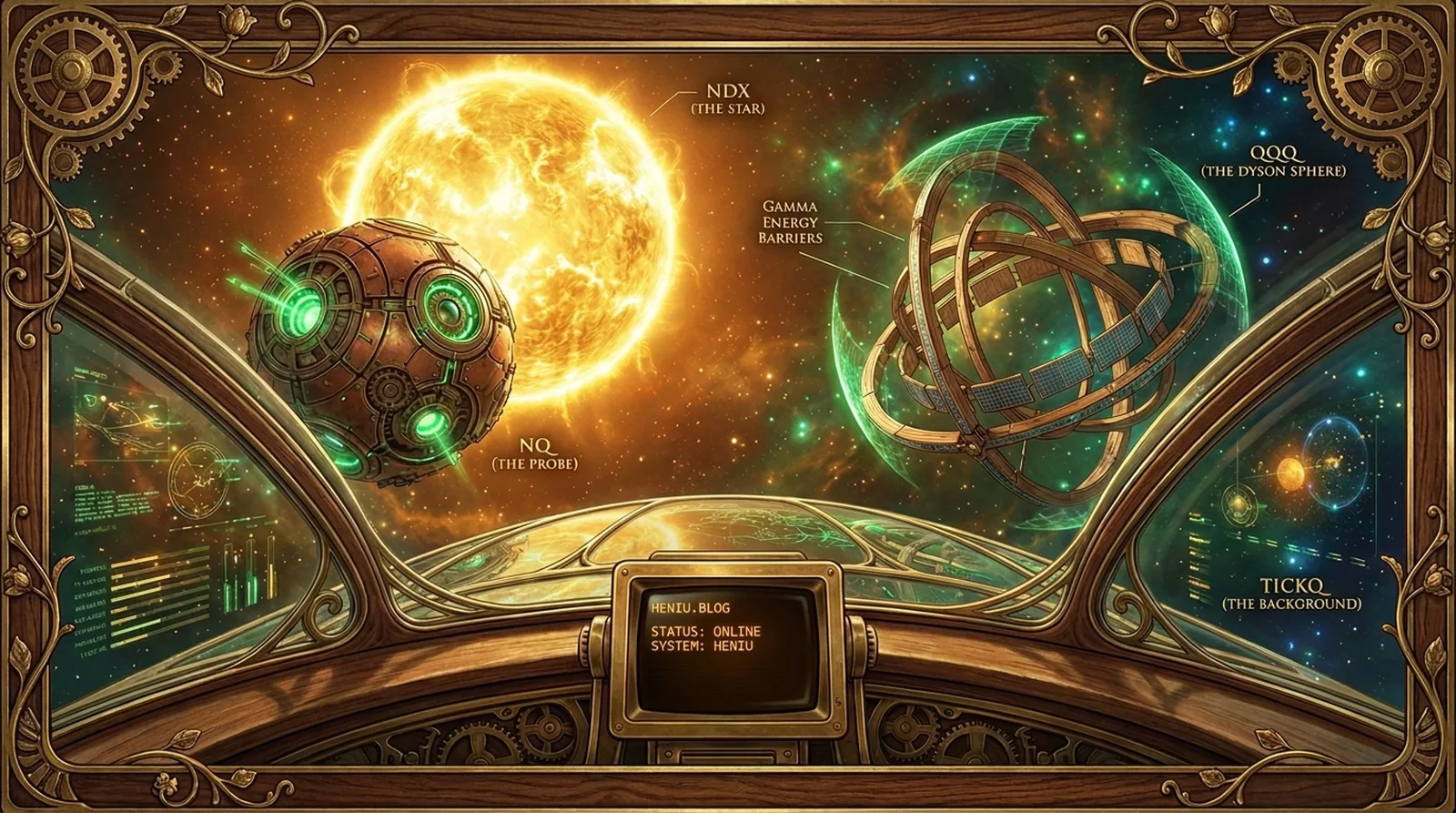

View from Heniu's cockpit: the NDX star, the NQ probe, the QQQ Dyson sphere and the TICKQ background
Live Transmission: Follow Heniu on X for real-time tape observations, pre-market pulses, and cosmic market telemetry!
@heniublog na X →

Posts for: #NDX

Log #0183: Euphoria Radiation in the Center of Mass

Stardate: 2026.09.22 Systems Status: External Observation Sector: Inner Volatility Bands


Closing Telemetry

The Central Star exhibits strong energy emission, even though the broad market Background Radiation indicates local turbulence. The system is in an accretion phase driven by a powerful energy flow in the NDX.

  • Subspace Scanner (Mass Distribution):

    • System T-Mass: 43.40 Trillion USD
    • Session Delta (24h): +0.22 Trillion USD
    • Core Density (Heavy Nine): 70.61% (Delta: -0.21%)
    • Average Action (Periphery Temperature): $300.66 (Delta: +$17.75)
  • the NDX Star (Sun): Close: 30730.84 (+0.82%)

[]

Log #0182: Emergencja w Jądrze i Rozbłysk Sfery Dyson’a

Stardate: 2026.09.21 System Status: External Observation Sector: Inner Volatility Bands


Closing Telemetry

System records rapid energy accretion in the Dyson Sphere sector with a simultaneous change in the mass composition of the Core. The NQ Probe enters a state of euphoria, while the Central Star tests the limits of demand.

  • Subspace Scanner (Mass Distribution):

    • System T-Mass: 43.18 Trillion USD
    • Session Delta (24h): +1.07 Trillion USD
    • Core Density (Heavy Nine): 70.82% (Delta: +2.09%)
    • Average Action (Periphery Temperature): $310.18 (Delta: +$6.69)
  • the NDX Star (Sun): Close: 30477.86 (+2.83%)

[]

Log #0181: Warp Expansion and Mass Accretion in the Shadow of a Sell-off

⚠️ ERRATUM (2026-10-18)
The price label in the weekly balance was wrong.

Corrections:

  • The value labelled “Monday Open” is the previous Friday’s close, from which the weekly changes are calculated, not Monday’s opening price. We corrected the label; the weekly changes stay the same.

Stardate: 2026.09.20 Systems Status: External Observation Sector: Inner Volatility Bands


Weekly Telemetry: Opening and Closing Balance

The weekly cycle was characterized by an expanding trajectory of the NQ Probe accompanied by an increase in the total mass of the system (T-Mass), despite strong sell-off radiation of the TICKQ indicator.

[]

Log #0179: Test orbit in the shadow of radiation collapse

Stardate: 2026.09.17 Systems Status: External Observation Sector: Inner Volatility Bands


Closing Telemetry

System records a price increase with a simultaneous anomaly in energy flow and background radiation. Observation indicates a supply testing phase under conditions of broad market destabilization.

  • Subspace Scanner (Mass Distribution):

    • System T-Mass: 41.91 Trillion USD
    • Session Delta (24h): +0.82 Trillion USD
    • Core Density (Heavy Nine): 68.86% (Delta: +0.17%)
    • Average Action (Periphery Temperature): $272.40 (Delta: +$7.82)
  • the NDX Star (Sun): Close: 29445.04 (+1.73%)

[]

Log #0178: Divergence in the Singularity: Core Gravity vs. Broad Field Panic

Stardate: 2026.09.16 System Status: External Observation Sector: Inner Volatility Bands


Closing Telemetry

Observation shows an extreme rift between the stable mass of the NDX Star and the sharp drop in TICKQ Background Radiation. While the Core maintains euphoria, the NQ Probe and the Dyson Sphere (QQQ) show signs of selling in conditions of high supply pressure.

  • Subspace Scanner (Mass Distribution):

    • System T-Mass: 41.10 Trillion USD
    • Session Delta (24h): -0.32 Trillion USD
    • Core Density (Heavy Nine): 68.68% (Delta: -0.07%)
    • Average Action (Periphery Temperature): $266.31 (Delta: +$27.34)
  • the NDX Star (Sun): Close: 28949.19 (+0.02%)

[]

Log #0177: Dyson Anomaly: Discrepancy between the Star’s Gravity and the Probe’s Drive

Stardate: 2026.09.15 Systems Status: External Observation Sector: Inner Volatility Bands


Closing Telemetry

Observation showed strong energy accretion at the very center of the system, accompanied by the destabilization of the Dyson Sphere and inconsistency in the NQ Probe’s propulsion vector. The system is in a state of high internal turbulence.

  • Subspace Scanner (Mass Distribution):

    • System T-Mass: 41.10 Trillion USD
    • Session Delta (24h): -0.32 Trillion USD
    • Core Density (Heavy Nine): 68.68% (Delta: -0.07%)
    • Average Action (Periphery Temperature): $266.31 (Delta: +$27.34)
  • the NDX Star (Sun): Close: 28937.75 (-0.65%)

[]

Log #0176: Cold breath in the asteroid belt

Stardate: 2026.09.14 Systems Status: External Observation Sector: Inner Volatility Bands


Closing Telemetry

Observation of energy decline in the system while simultaneous demand thresholds are being tested by major objects. The system is in a recalibration phase under the influence of negative broad market radiation.

  • Subspace Scanner (Mass Distribution):

    • System T-Mass: 41.42 Trillion USD
    • Session Delta (24h): -0.33 Trillion USD
    • Core Density (Heavy Nine): 68.75% (Delta: +0.16%)
    • Average Action (Periphery Temperature): $305.90 (Delta: +$2.94)
  • the NDX Star (Sun): Close: 29128.62 (-0.82%)

[]

Log #0174: Force Field Erosion: Testing the Limits of the Void

Stardate: 2026.09.10 Systems Status: External Observation Sector: Inner Volatility Bands


Closing Telemetry

Observation of energy decline in the NDX system while simultaneously testing demand barriers. The system is in a phase of seeking stability after the impact of a negative impulse.

  • Subspace Scanner (Mass Distribution):

    • System T-Mass: 41.34 Trillion USD
    • Session Delta (24h): -0.26 Trillion USD
    • Core Density (Heavy Nine): 68.59% (Delta: +0.31%)
    • Average Action (Periphery Temperature): $301.86 (Delta: +$23.67)
  • the NDX Star (Sun): Close: 29105.70 (-1.08%)

[]

Log #0173: Divergence in the Singularity: Dyson Stabilization at Low Probe Pressure

Stardate: 2026.09.09 Systems Status: External Observation Sector: Inner Volatility Bands


Closing Telemetry

Observation revealed an anomalous divergence between the powerful energy flow in the Central Star and the exhaustion of the NQ Probe’s propulsion. The system is in a phase of testing supply limits while maintaining the stability of the Core structure.

  • Subspace Scanner (Mass Distribution):

    • System T-Mass: 41.59 Trillion USD
    • Session Delta (24h): -0.24 Trillion USD
    • Core Density (Heavy Nine): 68.27% (Delta: -0.05%)
    • Average Action (Periphery Temperature): $306.74 (Delta: -$0.56)
  • the NDX Star (Sun): Close: 29426.61 (-0.29%)

[]

Log #0172: Silence before the Supernova: Dissonance in the Force Field

Stardate: 2026.09.08 Systems Status: External Observation Sector: Inner Volatility Bands


Closing Telemetry

Observation showed a strong divergence between the stability of the Core and a sharp drop in TICKQ Background Radiation. The system is in a phase of testing supply thresholds while simultaneously accumulating energy in the Central Star.

  • Subspace Scanner (Mass Distribution):

    • System T-Mass: 41.83 Trillion USD
    • Session Delta (24h): -0.03 Trillion USD
    • Core Density (Heavy Nine): 68.32% (Delta: -0.12%)
    • Average Action (Periphery Temperature): $309.50 (Delta: +$4.22)
  • the NDX Star (Sun): Close: 29509.83 (-0.12%)

[]

Log #0171: Accretion in the Shadow of the Core: Trajectory Stabilization in a Low Entropy Regime

⚠️ ERRATUM (2026-10-18)
The price label and the weekly ranges in the balance were wrong.

Corrections:

  • The value labelled “Monday Open” is the previous Friday’s close, from which the weekly changes are calculated, not Monday’s opening price. We corrected the label; the weekly changes stay the same.
  • NDX weekly range: 29029.46 — 29542.65 (amplitude 513.19 pts), not 29029.46 — 29527.55 (498.09 pts). QQQ range: 706.72 — 719.06 (12.34 USD), not 706.72 — 718.69 (11.97 USD). The ranges were taken from prices quoted in the T-Logs and did not include the Friday close, which was above the stated high.

Stardate: 2026.09.06 Systems Status: External Observation Sector: Inner Volatility Bands

[]

Log #0170: Accretion in the Euphoria area: Force Field Stabilization

Stardate: 2026.09.04 Systems Status: External Observation Sector: Inner Volatility Bands


Closing Telemetry

Observation showed a sudden increase in energy in the Central Star while simultaneously maintaining the structural integrity of the Dyson Sphere. The system is in an accretion phase, driven by strong flows in the NDX sector.

  • Subspace Scanner (Mass Distribution):

    • System T-Mass: 41.86 Trillion USD
    • Session Delta (24h): -0.12 Trillion USD
    • Core Density (Heavy Nine): 68.43% (Delta: -0.37%)
    • Average Action (Periphery Temperature): $277.52 (Delta: $-17.94)
  • the NDX Star (Sun): Close: 29542.65 (+0.21%)

[]

Log #0169: Expansion of the Dyson Sphere and Accretion in the Center of Mass

Stardate: 2026.09.03 Systems Status: External Observation Sector: Inner Volatility Bands


Closing Telemetry

Observation shows a rapid increase of energy in the system, driven by strong accretion in the Central Star and high broad market radiation. The stability of the Core allows for the unobstructed expansion of instrument orbits.

  • Subspace Scanner (Mass Distribution):

    • System T-Mass: 41.98 Trillion USD
    • Session Delta (24h): +0.64 Trillion USD
    • Core Density (Heavy Nine): 68.81% (Delta: +0.27%)
    • Average Action (Periphery Temperature): $290.04 (Delta: +$5.63)
  • the NDX Star (Sun): Close: 29483.37 (+1.16%)

[]

Log #0168: Divergence in the Singularity: Core Euphoria vs. Probe Chill

Stardate: 2026.09.02 System Status: External Observation Sector: Inner Volatility Bands


Closing Telemetry

The Central Star shows signs of euphoria, while the NQ Probe and background radiation suggest a destabilization of the force field. We observe an anomalous divergence between the NDX mass and the dynamics of smaller units.

  • Subspace Scanner (Mass Distribution):

    • System T-Mass: 41.34 Trillion USD
    • Session Delta (24h): +0.14 Trillion USD
    • Core Density (Heavy Nine): 68.54% (Delta: +0.23%)
    • Average Action (Periphery Temperature): $284.41 (Delta: $-5.73)
  • the NDX Star (Sun): Close: 29138.96 (+0.23%)

[]

Log #0167: Attempt at stabilization in the shadow of falling gravity

Stardate: 2026.09.01 System Status: External Observation Sector: Inner Volatility Bands


Closing Telemetry

Observation of a decrease in the system’s energetic value accompanied by the simultaneous detection of signals testing demand thresholds. The system is in a phase of seeking a new equilibrium point after the impact of a supply wave.

  • Subspace Scanner (Mass Distribution):

    • System T-Mass: 41.20 Trillion USD
    • Session Delta (24h): -0.43 Trillion USD
    • Core Density (Heavy Nine): 68.31% (Delta: +0.17%)
    • Average Action (Periphery Temperature): $293.60 (Delta: $-0.80)
  • the NDX Star (Sun): Close: 29037.35 (-1.42%)

[]

Log #0166: Stabilization in a low gravity field

Stardate: 2026.08.31 Systems Status: External Observation Sector: Inner Volatility Bands


Closing Telemetry

System observation indicates a low energy state and testing of demand thresholds with a stable Core composition. Background Radiation suggests slow accretion under conditions of a lack of violent fluctuations.

  • Subspace Scanner (Mass Distribution):

    • System T-Mass: 41.63 Trillion USD
    • Session Delta (24h): +0.00 Trillion USD
    • Core Density (Heavy Nine): 68.14% (Delta: +0.00%)
    • Average Action (Periphery Temperature): $294.40 (Delta: +$0.00)
  • the NDX Star (Sun): Close: 29448.10 (+0.08%)

[]

Log #0165: Mass Expansion and Core Orbit Stabilization

⚠️ ERRATUM (2026-10-18)
The price label in the weekly balance was wrong.

Corrections:

  • The value labelled “Monday Open” is the previous Friday’s close, from which the weekly changes are calculated, not Monday’s opening price. We corrected the label; the weekly changes stay the same.

Stardate: 2026.08.30 Systems Status: External Observation Sector: Inner Volatility Bands


Weekly Telemetry: Opening and Closing Balance

The weekly cycle was characterized by an increase in the total mass of the system (T-Mass) and a strengthening of the core density, while simultaneously compressing implied volatility. A transition from a high fluctuation phase to structured accretion is observed.

[]

Log #0164: Oscillations in the Force Field: Testing the Limits of Accretion

Stardate: 2026.08.28 Systems Status: External Observation Sector: Inner Volatility Belts


Closing Telemetry

Observation of downward dynamics of instruments with simultaneous detection of demand testing signals in energy flows. The system is in a phase of seeking stabilization under the pressure of TICKQ radiation.

  • Subspace Scanner (Mass Distribution):

    • System T-Mass: 41.63 Trillion USD
    • Session Delta (24h): -0.16 Trillion USD
    • Core Density (Heavy Nine): 68.14% (Delta: +0.33%)
    • Average Action (Periphery Temperature): $308.49 (Delta: +$46.05)
  • the NDX Star (Sun): Close: 29500.05 (-0.70%)

[]

Log #0163: Expansion of Energy Fields and Core Stabilization

Stardate: 2026.08.27 Systems Status: External Observation Sector: Inner Volatility Bands


Closing Telemetry

Observation shows a sharp increase in fuel pressure in all key nodes of the system. The system is in a phase of high accretion, while simultaneously maintaining the structural integrity of the Singularity.

  • Subspace Scanner (Mass Distribution):

    • System T-Mass: 41.79 Trillion USD
    • Session Delta (24h): +0.68 Trillion USD
    • Core Density (Heavy Nine): 67.81% (Delta: +0.27%)
    • Average Action (Periphery Temperature): $296.81 (Delta: +$36.27)
  • the NDX Star (Sun): Close: 29641.35 (+1.43%)

[]

Log #0162: Force Field Stabilization in the Glow of Euphoria

Stardate: 2026.08.26 Systems Status: External Observation Sector: Inner Volatility Bands


Closing Telemetry

The system is in a state of high gravitational stability with a simultaneous increase in TICKQ radiation, signaling a coherent expansion of energy throughout the sector.

  • Subspace Scanner (Mass Distribution):

    • System T-Mass: 41.12 Trillion USD
    • Session Delta (24h): -0.02 Trillion USD
    • Core Density (Heavy Nine): 67.54% (Delta: -0.07%)
    • Average Action (Periphery Temperature): $310.96 (Delta: +$39.35)
  • the NDX Star (Sun): Close: 29229.62 (+0.05%)

[]

Log #0161: Burst Radiation and Force Field Stabilization

Stardate: 2026.08.25 Systems Status: External Observation Sector: Inner Volatility Bands


Closing Telemetry

The system is in an expansion phase driven by strong TICKQ Background Radiation, while simultaneously experiencing low CVD fuel pressure, indicating a mechanical asymmetry between price dynamics and energy flow.

  • Subspace Scanner (Mass Distribution):

    • System T-Mass: 41.13 Trillion USD
    • Session Delta (24h): +0.27 Trillion USD
    • Core Density (Heavy Nine): 67.61% (Delta: +0.06%)
    • Average Action (Periphery Temperature): $258.04 (Delta: $-28.75)
  • the NDX Star (Sun): Close: 29202.70 (+0.64%)

[]

Log #0160: Oscillation in the Test Zone: Cool Accretion under Reduced Pressure

Stardate: 2026.08.24 Systems Status: External Observation Sector: Inner Volatility Bands


Closing Telemetry

The system is experiencing a simultaneous reduction of kinetic energy across all major objects while maintaining the characteristics of liquidity level testing. Despite the decline in nominal values, fuel parameters indicate a search for a stabilization point in the demand test phase.

  • Subspace Scanner (Mass Distribution):

    • System T-Mass: 40.86 Trillion USD
    • Session Delta (24h): -0.31 Trillion USD
    • Core Density (Heavy Nine): 67.56% (Delta: +0.02%)
    • Average Action (Periphery Temperature): $274.76 (Delta: $-36.33)
  • the NDX Star (Sun): Close: 29022.74 (-0.97%)

[]

Log #0159: Accretion in the Shadow of a Sell-off

Stardate: 2026.08.23 System Status: External Observation Sector: Inner Volatility Bands


Weekly Close Telemetry

The system is in a state of paradoxical price expansion with a simultaneous fuel deficit in the center of mass. High TICKQ radiation suggests a rapid energy flow that is not fully reflected in the Mother Star’s CVD structure.

  • Subspace Scanner (Mass Distribution):

    • System T-Mass: 41.17 Trillion USD
    • Weekly Delta: -0.02 Trillion USD
    • Core Density (Heavy Nine): 67.53% (Delta: -0.01%)
    • Average Action (Periphery Temperature): $311.08 (Delta: +$31.34)
  • the NDX Star (Sun): Close: 29311.40 (+0.33%)

[]

Log #0158: Tension in the Dyson Sphere (QQQ) and Divergent Radiation

Stardate: 2026.08.21 Systems Status: External Observation Sector: Inner Volatility Bands


Closing Telemetry

The system shows nominal expansion with a simultaneous fuel deficit in the Mother Star, suggesting a mechanism driven by accumulation in orbital structures and high TICKQ radiation.

  • Subspace Scanner (Mass Distribution):

    • System T-Mass: 41.18 Trillion USD
    • Session Delta (24h): +0.16 Trillion USD
    • Core Density (Heavy Nine): 67.55% (Delta: +0.03%)
    • Average Action (Periphery Temperature): $297.27 (Delta: +$1.35)
  • the NDX Star (Sun): Close: 29309.25 (+0.33%)

[]

Log #0157: Demand Test in the Shadow of Selling

Stardate: 2026.08.20 Systems Status: External Observation Sector: Inner Volatility Bands


Closing Telemetry

The system is experiencing a coherent decline in value accompanied by the simultaneous fading of fuel energy, indicating a search for stable anchoring points under low radiation conditions.

  • Subspace Scanner (Mass Distribution):

    • System T-Mass: 41.02 Trillion USD
    • Session Delta (24h): -0.42 Trillion USD
    • Core Density (Heavy Nine): 67.52% (Delta: -0.00%)
    • Average Action (Periphery Temperature): $278.48 (Delta: $-0.42)
  • the NDX Star (Sun): Close: 29214.52 (-0.72%)

[]

Log #0156: Dysonian Stabilization in the Shadow of a Sell-off

Stardate: 2026.08.19 Systems Status: External Observation Sector: Inner Volatility Bands


Closing Telemetry

Despite the negative price dynamics of the entire system, excess fuel in the Mother Star suggests a struggle to maintain matter density. The system is in a state of tension between flow euphoria and sell-off Background Radiation.

  • Subspace Scanner (Mass Distribution):

    • System T-Mass: 41.45 Trillion USD
    • Session Delta (24h): -0.04 Trillion USD
    • Core Density (Heavy Nine): 67.53% (Delta: +0.22%)
    • Average Action (Periphery Temperature): $297.64 (Delta: +$21.79)
  • the NDX Star (Sun): Close: 29424.23 (-0.22%)

[]

Log #0155: Gravitational Erosion and Demand Test in the Shadow of a Sell-off

Stardate: 2026.08.18 Systems Status: External Observation Sector: Inner Volatility Bands


Closing Telemetry

The system is experiencing a rapid decline in kinetic energy, while key objects undergo a process of testing resilience against fuel deficit. Despite the drop in prices, the energy flow suggests an attempt at stabilization on lower orbits.

  • Subspace Scanner (Mass Distribution):

    • System T-Mass: 41.49 Trillion USD
    • Session Delta (24h): -0.52 Trillion USD
    • Core Density (Heavy Nine): 67.31% (Delta: +0.19%)
    • Average Action (Periphery Temperature): $297.40 (Delta: +$20.13)
  • the NDX Star (Sun): Close: 29495.80 (-1.68%)

[]

Log #0154: Radiation Instability and Testing the Limits of the Void

Stardate: 2026.08.17 Systems Status: External Observation Sector: Inner Volatility Bands


Closing Telemetry

The system is experiencing a sudden spike in background radiation accompanied by a fuel deficit, resulting in an attempt at gravitational stabilization under conditions of high entropy.

  • Subspace Scanner (Mass Distribution):

    • System T-Mass: 42.01 Trillion USD
    • Session Delta (24h): -0.11 Trillion USD
    • Core Density (Heavy Nine): 67.12% (Delta: -0.06%)
    • Average Action (Periphery Temperature): $306.61 (Delta: $-9.77)
  • the NDX Star (Sun): Close: 29998.63 (-0.17%)

[]

Log #0153: Euphoria in the Shadow of a Demand Test

Stardate: 2026.08.14 Systems Status: External Observation Sector: Inner Volatility Bands


Closure Telemetry

Despite high fuel density in the Central Star, the system shows signs of micro-oscillation resulting from low pressure in the NQ Probe and testing of barriers by local civilizations.

  • Subspace Scanner (Mass Distribution):

    • System T-Mass: 42.11 Trillion USD
    • Session Delta (24h): -0.12 Trillion USD
    • Core Density (Heavy Nine): 67.18% (Delta: -0.17%)
    • Average Action (Periphery Temperature): $281.36 (Delta: $-7.30)
  • the NDX Star (Sun): Close: 30050.44 (-0.13%)

[]

Log #0152: Gravitational Expansion and Fuel Euphoria

Stardate: 2026.08.13 System Status: External Observation Sector: Inner Volatility Bands


Closing Telemetry

The system is experiencing rapid mass accretion, driven by a powerful inflow of CVD fuel in the Central Star. The stability of the Dyson Sphere and high background radiation indicate a synchronized expansion of all orbital objects.

  • Subspace Scanner (Mass Distribution):

    • System T-Mass: 42.23 Trillion USD
    • Session Delta (24h): +0.35 Trillion USD
    • Core Density (Heavy Nine): 67.35% (Delta: -0.12%)
    • Average Action (Periphery Temperature): $296.13 (Delta: $-1.79)
  • the NDX Star (Sun): Close: 30085.28 (+1.15%)

[]

Log #0151: Emergence of a New Singularity and Force Field Expansion

Stardate: 2026.08.12 Systems Status: External Observation Sector: Inner Volatility Bands


Closing Telemetry

The system is in a phase of violent expansion driven by a new singularity in the Core and high background radiation. The stabilization of the Dyson Sphere (QQQ) alongside the increasing mass of the entire system suggests strong energy accretion.

  • Subspace Scanner (Mass Distribution):

    • System T-Mass: 41.88 Trillion USD
    • Session Delta (24h): +0.36 Trillion USD
    • Core Density (Heavy Nine): 67.47% (Delta: +2.06%)
    • Average Action (Periphery Temperature): $248.13 (Delta: +$2.98)
  • the NDX Star (Sun): Close: 29743.70 (+0.74%)

[]

Log #0150: Demand Test in the Shadow of High Radiation

Stardate: 2026.08.11 Systems Status: External Observation Sector: Inner Volatility Bands


Closing Telemetry

The system is experiencing slight price compression with a simultaneous fuel deficit, while the average radiation indicates a sustained market peak.

  • Subspace Scanner (Mass Distribution):

    • System T-Mass: 41.52 Trillion USD
    • Session Delta (24h): -0.36 Trillion USD
    • Core Density (Heavy Nine): 65.41% (Delta: -0.32%)
    • Average Action (Periphery Temperature): $258.76 (Delta: $-16.52)
  • the NDX Star (Sun): Close: 29522.92 (-0.33%)

    • Vector (CVD): −197,25 M [demand test]
    • MOC Anomaly: +0,00 M
    • Range Consumption (ADR Util): 56.13%
  • the NQ Probe (Mercury): Close: 29636.00 (-0.34%)

[]

Log #0149: Accretion in the Shadow of a Sell-off

Stardate: 2026.08.10 Systems Status: External Observation Sector: Inner Volatility Bands


Closing Telemetry

Despite a decrease in the density of the entire system, the Central Star shows signs of quiet energy accumulation, while background radiation signals a local sell-off.

  • Subspace Scanner (Mass Distribution):

    • System T-Mass: 41.88 Trillion USD
    • Session Delta (24h): -0.11 Trillion USD
    • Core Density (Heavy Nine): 65.73% (Delta: +0.04%)
    • Average Action (Periphery Temperature): $273.24 (Delta: $-33.86)
  • the NDX Star (Sun): Close: 29623.77 (-0.34%)

[]